


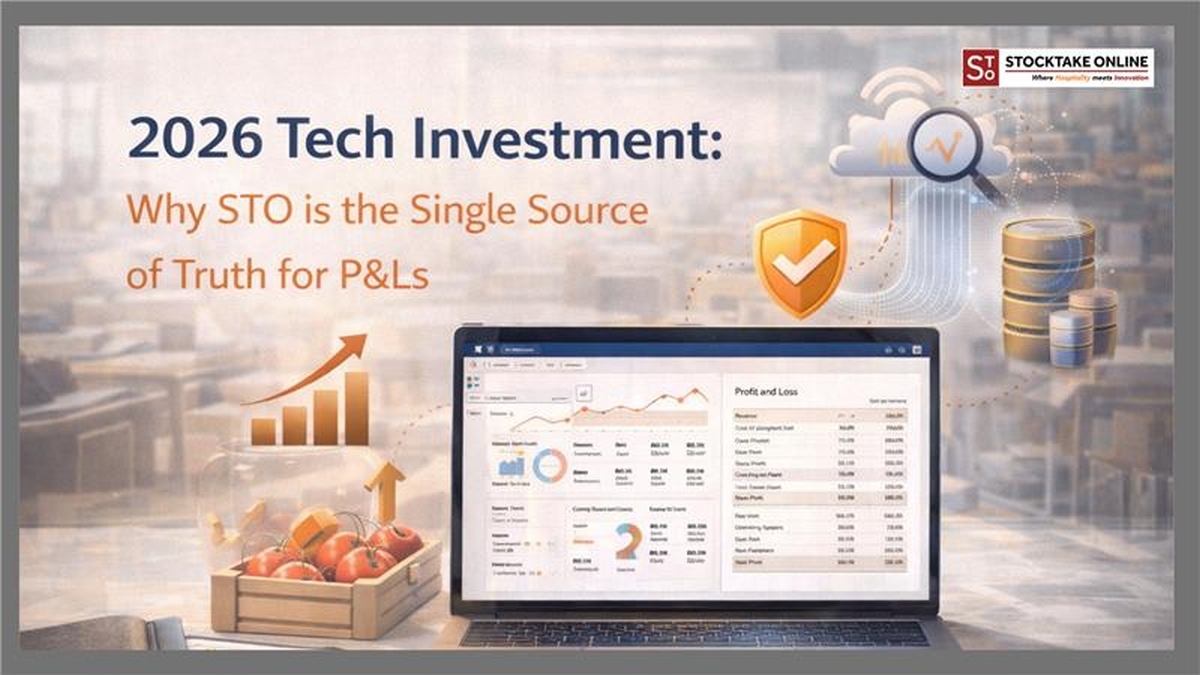
As we navigate the fiscal landscape of 2026, the hospitality industry faces an unprecedented convergence of operational pressures. Margin erosion, driven by volatile global supply chains and fluctuating labour costs, has rendered traditional, reactive accounting methods obsolete. For a modern Profit and Loss (P&L) statement to be a functional tool rather than a historical post-mortem, it requires a "Single Source of Truth."
Stocktake Online (STO) has emerged as the definitive platform for this requirement. By bridging the gap between physical inventory and financial reporting, STO ensures that Cost of Goods Sold (COGS) is calculated with surgical precision. In an era where AI-driven insights and real-time data dictate market leaders, relying on fragmented spreadsheets or disconnected POS data is a strategic risk. This article explores why STO is the essential tech investment for 2026, providing the data integrity needed to protect the bottom line in an increasingly complex F&B environment.
Industry & Market Context
The hospitality sector in 2026 is defined by "The Great Tightening." While consumer demand remains resilient, the cost of doing business has shifted permanently. Food inflation, though stabilised compared to the shocks of the early 2020s, remains sensitive to geopolitical shifts and climate-impacted harvests. Furthermore, the rise of multi-site operations and diverse revenue streams—ranging from traditional dining to sophisticated cloud kitchen models—has made inventory oversight exponentially more difficult.
Operators are no longer just managing a kitchen; they are managing a high-velocity supply chain. The complexity of modern recipes, often requiring specialised ingredients with short shelf lives, means that even a 2% variance in stock accuracy can lead to a double-digit hit on net profit. Labour remains the second-highest expense, and the time spent by management on manual data entry is a cost that 2026 margins simply cannot absorb. Consequently, the industry is pivoting toward automated, cloud-based ecosystems that offer a holistic view of the business.
Operational Problems: The Cost of Fragmented Data
The primary barrier to a clean P&L is the "data silo." In many operations, the purchasing department uses one system, the kitchen uses paper checklists, and the finance team relies on month-end reports from a POS that doesn't account for actual stock on hand.
Inaccurate Stocktakes and Invisible Waste.
Manual stocktakes are prone to human error. Whether it is miscounting units or failing to account for "work in progress" (WIP) items, the result is a distorted opening and closing stock figure. Without a unified system, waste remains invisible. If a chef tosses out £500 worth of spoiled protein but it isn't recorded against a specific waste reason, the P&L simply reflects a higher COGS, leaving management unable to identify whether the issue is theft, over-ordering, or poor storage.
The Variance Trap
Variance—the difference between theoretical usage (what should have been used based on sales) and actual usage (what was physically consumed)—is the "silent killer" of hospitality margins. Many operators only discover significant variances weeks after they occur, making it impossible to trace the root cause. This lack of real-time visibility prevents the implementation of corrective actions, such as portion control training or supplier price renegotiation.
Financial Impact: Margin Erosion and Cash Flow
The financial implications of poor inventory control extend far beyond the kitchen. For a CFO, an inaccurate inventory count means the balance sheet is fundamentally flawed.
-
COGS Volatility: Without the precise data provided by Stocktake Online features, COGS becomes a moving target. This volatility makes it impossible to set accurate menu prices, often leading to "menu creep" where prices are raised unnecessarily, or worse, not raised enough to cover costs.
-
Cash Flow Deadlock: Over-ordering traps capital in the storeroom. In 2026, cash is king. Stock sitting on shelves is "dead money" that could be better utilised for marketing, maintenance, or expansion. Conversely, under-ordering leads to "out-of-stock" scenarios, resulting in lost revenue and diminished customer loyalty.
-
Inaccurate Forecasting: Financial planning for 2026 requires predictive accuracy. If the historical data fed into a P&L is "dirty," any future projections will be inherently unreliable, leading to poor strategic decisions regarding scaling or investment.
Modern Solution Framework: The 2026 Standard
A 2026-ready inventory system is not a digital ledger; it is a dynamic operational engine. To achieve a single source of truth, the framework must integrate several core pillars:
-
Real-Time Data Synchronisation: The system must sync with the POS and supplier portals instantly.
-
Mobile-First Execution: Stock counts must be performed on-the-go via mobile devices to eliminate the "paper-to-spreadsheet" error margin.
-
Invoice Digitisation: Optical Character Recognition (OCR) technology should automatically ingest supplier invoices, updating prices and stock levels without manual entry.
-
AI-Driven Forecasting: Leveraging historical data to predict future stock needs based on seasonal trends, events, and weather patterns.
Granular Recipe Costing: Every ingredient must be tracked down to the gram, including yields and wastage factors.
By implementing these pillabrs, an organisation moves from a "guess-and-check" model to a "data-driven" culture.
How Stocktake Online Delivers These Capabilities
Stocktake Online (STO) is engineered specifically to be the financial heartbeat of a hospitality business. It doesn't just record data; it validates it.
Unified Inventory Management
STO provides a centralized platform where inventory management meets financial reporting. By integrating directly with a vast array of partner integrations, STO pulls sales data and pushes stock requirements, ensuring that every department is looking at the same numbers.
Precision COGS and GP Tracking
The platform's ability to calculate the "True GP" is what sets it apart. By accounting for every variable—from delivery discrepancies to recipe yields—STO provides a P&L-ready COGS figure that auditors and CFOs can trust. Our value-added inventory services further support businesses by providing professional oversight to ensure these systems are utilised to their full potential.
Multi-Site Oversight
For enterprise-level operators, STO offers a "Control Tower" view. Managers can compare performance across multiple locations, identifying why one site achieves a 75% GP while another struggles at 68%. This level of transparency is essential for maintaining brand standards and financial health across a growing estate. To understand how this fits into your budget, visit our pricing page.
Industry Use Cases
-
Fine Dining & Hotels: Managing high-value inventory like wine cellars and premium proteins requires absolute precision. STO's granular tracking prevents "shrinkage" and ensures that high-margin items are contributing correctly to the P&L.
-
Quick Service Restaurants (QSR): In high-volume environments, speed is everything. STO's mobile counting and rapid invoice processing allow QSR managers to focus on throughput without losing sight of stock levels.
-
Cloud Kitchens: With no "front-of-house" to buffer costs, cloud kitchens rely entirely on BOH efficiency. STO’s integrations with delivery platforms ensure that stock is deducted accurately for every virtual brand managed.
Best Practices & Action Frameworks
To turn STO into your single source of truth, follow this discipline-focused framework:
The "Clean Data" Checklist
-
Weekly Mini-Counts: Do not wait for the end of the month. Perform "spot checks" on high-value items (Key Item Tracking) every Monday.
-
Immediate Waste Entry: Mandate that all waste—whether "prep waste" or "spoilage"—is entered into STO the moment it occurs.
-
Recipe Audits: Review your top 10 selling dishes every quarter to ensure the recipe costs in STO match the physical reality in the kitchen.
Supplier Negotiation Workflow
Use STO's purchase history reports to negotiate better rates. When you have hard data showing you spent £50,000 on poultry across six sites last year, you have the leverage to demand "contract pricing" rather than "market pricing."
AI & Future Trends
Looking beyond 2026, the integration of Machine Learning (ML) will move STO from "descriptive" to "prescriptive" analytics. We are moving toward a world where the system doesn't just tell you that you are out of milk; it predicts the shortage three days in advance based on a local bank holiday and automatically places the order with your preferred supplier. The "Single Source of Truth" will eventually become an "Autonomous Source of Action."
FAQs
-
How does STO improve P&L accuracy? By providing real-time COGS data and eliminating manual entry errors, STO ensures the "food cost" line on your P&L reflects physical reality, not just a theoretical estimate.
-
Can STO integrate with my existing POS? Yes, we have an extensive list of partner integrations that allow for seamless data flow between sales and inventory.
-
What is the ROI of an inventory management system? Most clients see a 2–5% reduction in COGS within the first six months, often paying for the software within weeks through waste reduction alone.
-
How does the system handle multi-site reporting? STO features a consolidated dashboard where you can view individual site performance or grouped regional data at the click of a button.
-
Does STO help with recipe costing? Absolutely. You can build complex, multi-level recipes that automatically update their cost-per-portion as supplier prices fluctuate.
-
Is the software easy for kitchen staff to use? Yes, our mobile interface is designed for the heat of the kitchen—intuitive, fast, and accessible on any smartphone or tablet.
-
How do you handle supplier price changes? Through invoice digitisation, the system identifies price creeps immediately, alerting you if a supplier has charged more than the agreed contract price.
-
Can I track "non-food" items? Yes, STO is used to track cleaning supplies, uniforms, and any other consumables that impact your operational expenses.
Conclusion
In the competitive landscape of 2026, data integrity is no longer a luxury; it is a survival trait. A P&L is only as good as the data that feeds it. By adopting Stocktake Online as your single source of truth, you eliminate the guesswork, protect your margins, and empower your leadership team to make decisions based on fact, not intuition.
To see how we can transform your operational visibility and secure your financial future, about us or contact us today for a personalized demo.
| About Stocktake Online Stocktake Online is a leading cloud-based restaurant and hospitality inventory management software trusted by thousands of businesses worldwide. With over a decade of industry expertise and a 4.7+ star customer rating, the platform empowers restaurants, hotels, bars, catering companies, and cloud kitchens to optimise ordering, control costs, reduce waste, and maintain accurate real-time stock visibility across single or multi-site operations. Learn more at www.stocktake-online.com |