


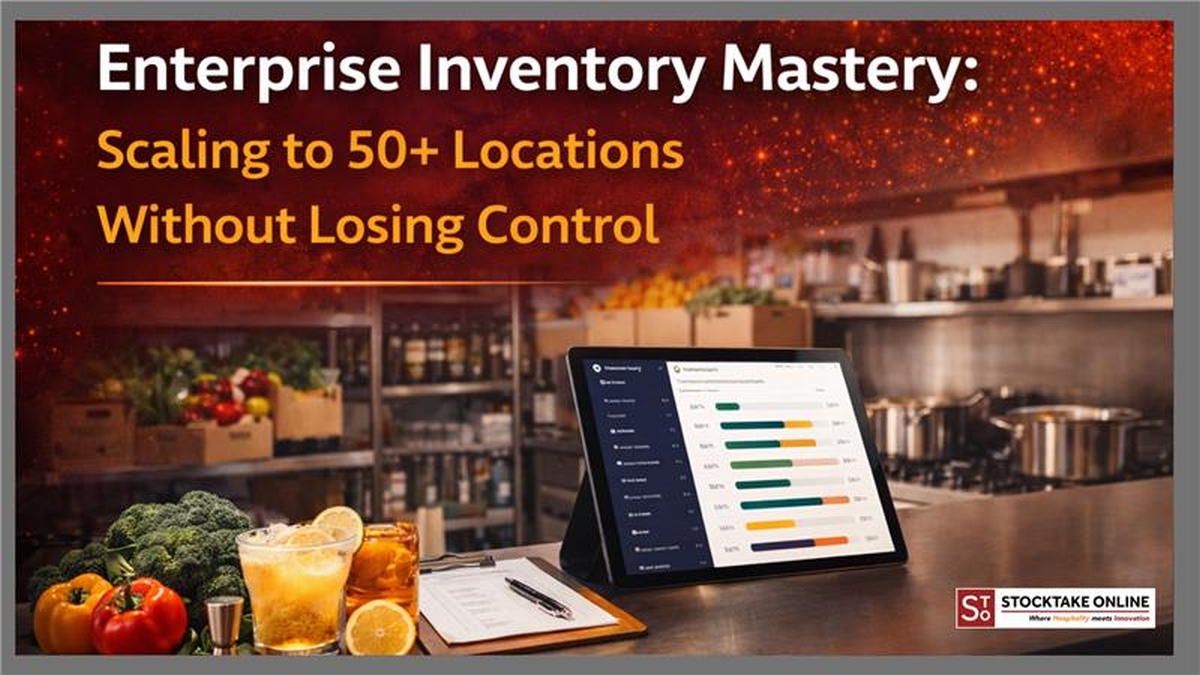
When a hospitality group expands from ten to fifty sites, the primary threat to survival is rarely a lack of customer demand. According to recent industry analysis on UK hospitality growth, the most common point of failure is operational drift. At ten sites, a founder or operations director can still maintain a degree of personal oversight. At fifty sites, that is physically impossible. The organisation loses its ability to manage the minutiae of the back of house, and the first casualty is almost always the inventory. Without a robust system, the cumulative effect of minor variances across dozens of kitchens can erode the bottom line by 3 to 5 percentage points, often before the finance team even spots the trend.
Why Inventory Fails First at Enterprise Scale
Multi-unit hospitality groups do not usually collapse due to a single catastrophic event. Instead, they suffer from death by a thousand cuts, where financial loss occurs through thousands of minor, repeated errors. When a group scales without centralized multi-unit inventory software features, individual sites begin ordering based on historical habits rather than actual consumption levels.
Consistency is the second victim of unmanaged scale. Without a unified system, different chefs create different versions of the same standardised recipe, leading to unpredictable yields. Furthermore, supplier pricing often fluctuates without immediate visibility at the head office level. When these discrepancies are multiplied by fifty locations, the one percent drift that seemed negligible at a single site becomes a material financial crisis that threatens the viability of the entire group.
The Enterprise Shift From Site Control to System Control
Successful enterprise operators treat inventory management as an essential central business function rather than a local chore. Scaling requires a shift from manager-dependent workflows to system-led implementations. This means ensuring that all locations share one central source of accurate information where operational data is visible in real time.
A high-performing inventory and POS integration allows the central office to set purchasing rules that control buying decisions at the local level. Instead of allowing managers to eyeball the walk-in, the system generates suggested orders based on actual sales data. This transition ensures that central purchasing guidelines are applied universally, protecting the group cash flow and preventing the accumulation of perishable dead stock across the network.
What Enterprise Mastery Looks Like in Practice
In a mature enterprise environment, leadership can see performance instantly across the entire network. Teams use variance as their primary operational metric, monitoring it throughout the day rather than waiting for a postmortem report at the end of the month. This proactive approach allows for immediate corrections. For example, if a specific site in the North shows a sudden spike in steak waste, the regional manager can investigate the cause before it impacts the weekly P and L.
Platforms like StockTake Online Facilitate this by providing a single system that operates in real time across all locations. By connecting inventory data with recipes, purchasing, and automated invoice scanning, the software ensures that finance departments are not chasing paper at month end. Instead, they have clean, reconciled data that makes the forecasting process dependable. This level of control allows organizational leaders to grow their operations with the confidence that their margins are protected at every new site rollout.
Conclusion
Expanding to 50 sites is a test of systems, not just a test of brand. The complexity of managing fifty separate supply chains and hundreds of staff members requires a disciplined approach to the back of house. Hospitality groups that invest in inventory as a core enterprise system are the ones that survive the transition from a local favorite to a national powerhouse. By moving inventory from a background task to a central operational responsibility, you create the foundation for sustainable, profitable growth.
FAQ
Why does inventory management become difficult during expansion? The difficulty arises because minor inaccuracies at one site are multiplied by fifty. Non centralised data leads to discrepancies in recipe execution, ordering patterns, and supplier pricing that are impossible to track manually.
Is enterprise software only for groups with over 50 sites? No. Most operators feel the strain as soon as they cross the 10 site mark. Implementing these systems early prevents the need for costly operational rework during the most aggressive phases of growth.
How does centralised inventory support faster expansion? It provides a blueprint for new sites. Standardised procedures and pre loaded recipe data allow new locations to open with immediate margin control, reducing the typical profit fluctuations seen during a launch phase.
Can I see a demonstration of how this works at scale? You can book an enterprise consultation with the specialist team to see how multi unit inventory mastery works in a live environment.

| About Stocktake Online Stocktake Online is a leading cloud-based restaurant and hospitality inventory management software trusted by thousands of businesses worldwide. With over a decade of industry expertise and a 4.7+ star customer rating, the platform empowers restaurants, hotels, bars, catering companies, and cloud kitchens to optimise ordering, control costs, reduce waste, and maintain accurate real-time stock visibility across single or multi-site operations. Learn more at www.stocktake-online.com |