



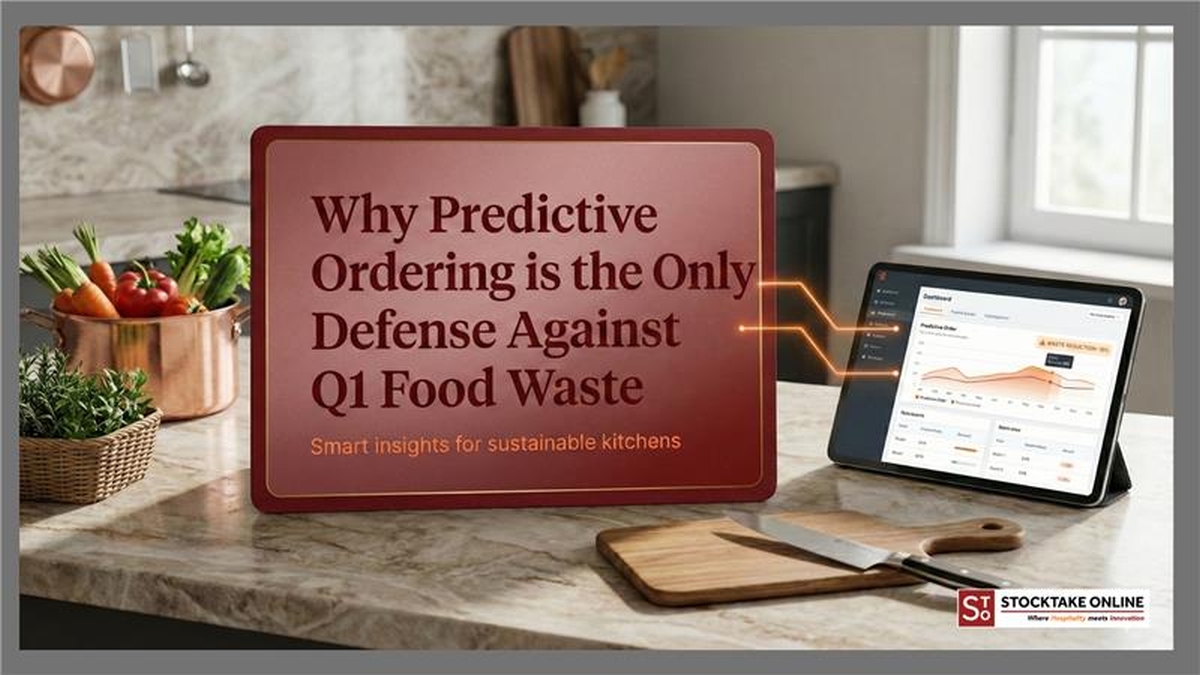
The first quarter of the year has historically been a graveyard for hospitality margins. Following the high volume of December, Q1 often brings a dangerous combination of erratic footfall, supply chain adjustments, and the inevitable "post-holiday slump." In 2026, relying on manual par levels or "gut-feel" procurement is no longer a sustainable operational strategy. The variance between theoretical usage and actual sales during this volatile period can decimate gross profit (GP) if not managed with precision.
This article explores why predictive ordering for restaurants has evolved from a luxury feature to a critical defense mechanism. By leveraging AI-driven insights to align procurement strictly with demand, operators can eliminate the overstocking that leads to spoilage. We will examine the financial mechanics of predictive demand planning for F&B, the operational shift required to implement it, and how Stocktake Online enables this transition to protect your bottom line.
Industry & Market Context: The 2026 Operations Landscape
The hospitality sector in 2026 is operating under a "zero-error" mandate. Input costs across the UK, Europe, and GCC regions remain elevated, meaning every kilogram of wasted ingredients represents a direct hit to net profit.
- The Q1 Volatility Trap: In January and February, consumer behaviour shifts. The "New Year, New Me" health trends alter menu mix preference, while reduced disposable income impacts average spend. Traditional static par levels fail here because they look at historical averages rather than forward-looking trends.
- Supply Chain Complexity: Hospitality supply chain management has become increasingly fragmented. Suppliers are tightening their own inventories, leading to shorter lead times but stricter minimum order quantities (MOQs).
- The Data Deficit: Too many operators are still using restaurant inventory management software solely for counting stock, ignoring its capability to forecast future needs. This reactive approach—counting what you have rather than predicting what you need—is the primary driver of preventable waste.
As outlined in our Global SEO & Content Strategy, the industry is pivoting toward AI-powered restaurant inventory management, where the software doesn't just record data—it interprets it to make purchasing decisions.
Operational Problems: The Cost of "Gut-Feel" Procurement
Why do experienced chefs and seasoned General Managers still struggle with waste reduction in restaurants? The answer lies in the limitations of human cognitive processing when faced with complex, multivariate data.
- The "Safety Stock" Fallacy: Fear of running out (stockouts) drives staff to over-order. A chef might order 10% extra "just in case." Across a multi-site operation, this buffer stock aggregates into massive capital tied up on shelves, eventually turning into spoilage.
- Static Par Levels in a Dynamic Market: A par level set in November is toxic in February. If your kitchen stock management software isn't dynamically adjusting pars based on recent sales velocity and seasonal dips, you are effectively ordering for a ghost dining room.
- The Disconnect Between Sales and Orders: Without POS integration for restaurants, there is a lag between what is sold and what is ordered. Purchasing managers often lack real-time visibility into theoretical usage, leading to orders based on what the shelf looks like, rather than what the data says.
+1 - Phantom Inventory: Inaccurate counting leads to phantom inventory—where the system thinks you have stock you don't (or vice versa). This corrupts any manual forecasting attempts, making inventory forecasting in hospitality impossible without digital intervention.
Financial Impact: The Hidden Cost of Q1 Waste
The financial damage of poor ordering protocols in Q1 extends far beyond the cost of the food itself. When we discuss food cost control software for restaurants, we are looking at a composite loss structure:
- COGS Inflation: Over-ordering by even 5% can inflate Cost of Goods Sold (COGS) disproportionately due to the spoilage of high-value perishables (proteins, fresh produce).
- Labour Cost Leakage: Handling, rotating, counting, and eventually disposing of excess stock costs labour hours. Your team is being paid to manage waste rather than serve guests.
- Cash Flow Stagnation: In Q1, cash flow is often tightest. Inventory sitting on a shelf is effectively liquid cash that has been frozen. Hospitality cost control software is essential to unfreeze this capital.
- Disposal Fees: In the UK and Europe specifically, commercial food waste disposal fees are rising. You pay to buy the food, pay to store it, and pay to throw it away—a triple penalty on profitability.
Implementing a food waste cost calculator for restaurants often reveals that "minor" ordering errors are costing single locations thousands in quarterly net profit.
Modern Solution Framework: What is Predictive Ordering?
Predictive ordering for restaurants is the application of algorithmic logic to procurement. Unlike basic auto-replenishment, which simply refills to a static number, predictive systems analyse multiple data points to generate a recommended purchase order.
A 2026-ready system must synthesise:
- Historical Sales Data: What did we sell this time last year?
- Recent Consumption Trends: Is the vegan burger trending up significantly in the last 4 weeks?
- Seasonality Factors: Adjusting for "Dry January" or Valentine's Day spikes.
- Stock-on-Hand: Real-time integration with your digital stocktaking solution.
Key Capabilities:
- Dynamic Par Levels: The system automatically lowers pars for Q1 lulls and raises them for specific events.
- Suggested Ordering: The software drafts the Purchase Order (PO) for the chef to review, removing the "blank sheet of paper" anxiety.
- Variance Alerts: Flagging if a proposed order deviates significantly from the AI-driven food cost control
How Stocktake Online Delivers Predictive Precision
At Stocktake Online, we have engineered our platform to move beyond passive tracking into active operational support. Our architecture is designed to support the 40–40–20 keyword model, balancing core inventory functions with advanced AI capabilities.
- Real-Time POS Integration By integrating directly with your Point of Sale, Stocktake Online captures granular sales data. This allows for precise menu and recipe costing, ensuring that every order recommendation is based on actual depletion, not guesswork.
- Smart Forecasting Algorithms Our inventory forecasting in hospitality tools analyse your consumption patterns. If you typically sell 20% less fillet steak in January, Stocktake Online’s algorithms detect this trend and adjust the recommended order accordingly, preventing costly protein waste.
- Automated Purchase Orders We streamline the supplier order management for restaurants. The system can generate draft orders across multiple suppliers simultaneously, ensuring you meet MOQs without over-ordering. This feature is critical for multi-site inventory tracking, allowing head office to approve orders centrally.
- Waste and Variance Reporting Prevention is better than cure, but visibility is key. Our waste and variance reporting modules allow you to track exactly why waste is happening—whether it’s spoilage (over-ordering) or prep errors—enabling you to refine your predictive parameters over time.
Explore our full suite of tools at Features.
Region-Specific Insights
- UK & Europe: With strict new legislation on food waste reporting coming into effect, hospitality stock compliance software is becoming mandatory. Predictive ordering helps UK operators stay ahead of these regulatory curves while mitigating high import costs post-Brexit.
- GCC / MENA: In markets like Dubai and Riyadh, where cloud kitchen inventory management is booming, the speed of turnover is incredibly high. Predictive ordering software GCC is essential for these high-volume, low-margin models where shelf life is measured in hours, not days.
+2 - USA & Canada: For our North American partners, the focus is often on labour reduction. AI invoice scanning for hospitality combined with predictive ordering reduces the administrative burden on managers, combatting the ongoing labour shortage.
Industry Use Cases
The Fine Dining Establishment
- Challenge: High cost of ingredients (truffles, wagyu, fresh seafood). Over-ordering leads to massive financial loss.
- Solution: Real-time inventory tracking combined with predictive analytics ensures high-value items are ordered "just-in-time," maintaining freshness while eliminating waste.
The Multi-Site QSR Chain
- Challenge: Standardisation across 50+ locations. Managers ordering wildly different amounts for the same volume.
- Solution: Head office uses multi-location restaurant inventory solutions to set algorithm-based ordering limits. If a manager tries to order 300% of the predicted need, the system flags it for review.
The Cloud Kitchen
- Challenge: Zero walk-in traffic; demand is 100% digital and volatile.
- Solution: Cloud kitchen stock control software utilises machine learning for restaurant inventory forecasting to correlate platform orders (UberEats, Deliveroo) with stock needs instantly.
Best Practices & Action Frameworks for Q1
To successfully implement predictive ordering, operators must follow a disciplined workflow:
- Clean Your Data: Garbage in, garbage out. Ensure all recipes are accurate in your recipe costing software and that stock counts are up to date.
- Establish a Baseline: Run a monthly stocktake process to get a verified opening stock figure. Use our Services if you need an external audit to reset your baseline.
- Configure Min/Max Levels: While AI helps, setting hard "safety stock" limits for critical items (e.g., coffee, house wine) ensures you never run dry during unexpected rushes.
- Review the Suggested Order: Train chefs to treat the AI suggestion as a strong recommendation, not a law. Human insight regarding local events (e.g., a nearby concert) is still valuable.
- Monitor Variance Weekly: Use variance tracking in restaurant inventory to see if the predictive model is aligning with reality. If variance remains high, investigate portion control or theft.
AI & Future Trends
The future of AI-powered restaurant inventory management is moving toward "autonomous procurement."
- Confidence Scoring: Systems will soon provide a "confidence score" for their predictions (e.g., "95% certain you will need 40kg of flour").
- Weather Integration: Predictive ordering software for restaurants will integrate live weather data to adjust par levels automatically (e.g., ordering more salad for a heatwave, more root veg for a cold snap).
- Voice-Activated Checks: Imagine asking, "Hey System, what is my stock of Ribeye?"—a feature emerging in voice assistant inventory check for restaurants.
FAQs
Q: How accurate is predictive ordering for restaurants? A: When powered by accurate sales history and recipe data, predictive ordering software can achieve accuracy rates of over 90%, significantly outperforming manual estimation.
Q: Can AI really reduce food waste in restaurant operations? A: Yes. By aligning purchasing strictly with predictive demand planning, operators typically see a reduction in food waste of 2–5% of total food costs within the first quarter of implementation.
Q: Does Stocktake Online integrate with my suppliers? A: Absolutely. Our supplier management software for hospitality connects directly with vendors to automate PO dispatch and streamline hospitality invoice automation.
Q: Is this suitable for small independent cafes? A: predictive logic benefits businesses of all sizes. Even a single site benefits from food and beverage inventory software by freeing up the owner's time and cash flow.
Q: How does it handle seasonality? A: Advanced machine learning for restaurant inventory forecasting identifies seasonal patterns in your historical data (e.g., lower sales in Jan, higher in Dec) and adjusts ordering recommendations automatically.
Conclusion
The margin for error in 2026 is non-existent. Q1 presents a unique set of challenges that manual processes simply cannot handle efficiently. Adopting predictive ordering for restaurants is not just about adopting new technology; it is about adopting a new financial discipline. It is the only viable defense against the margin-eroding effects of food waste and operational inefficiency.
Don't let "gut feel" dictate your profitability this quarter. Equip your team with the data they need to make smarter, faster, and more profitable purchasing decisions.
Ready to secure your margins for 2026? Book a specific demo today to see our predictive features in action, or explore our Pricing to find a plan that fits your operation.
| About Stocktake Online Stocktake Online is a leading cloud-based restaurant and hospitality inventory management software trusted by thousands of businesses worldwide. With over a decade of industry expertise and a 4.7+ star customer rating, the platform empowers restaurants, hotels, bars, catering companies, and cloud kitchens to optimise ordering, control costs, reduce waste, and maintain accurate real-time stock visibility across single or multi-site operations. Learn more at www.stocktake-online.com |