



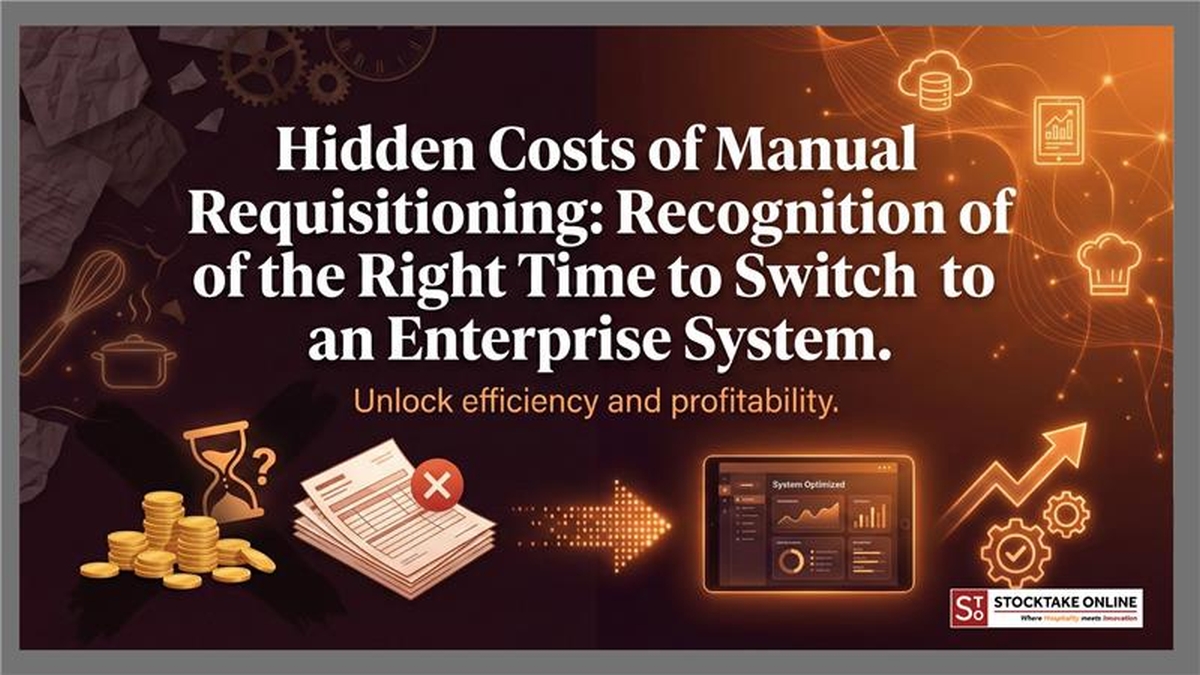
In the current hospitality climate of 2026, a paradox plagues growing restaurant groups and hotel chains: as revenue and site counts increase, operational control often diminishes. Operations Directors and CFOs frequently find that despite operations running "smoothly" on the surface, Gross Profit (GP) varies wildly between sites, stock-outs become frequent, and margins erode without a clear cause. The issue is rarely a lack of effort or demand; it is almost invariably the result of manual requisitioning.
What functions as a convenient, agile process for a single location—ordering via text, email, or spreadsheet—metastasises into a costly bottleneck at scale. This article explores the hidden financial and operational dangers of persisting with manual procurement as a multi-site operator. We examine the transition from reactive purchasing to proactive, data-driven enterprise inventory systems, highlighting how platforms like Stocktake Online transform internal stock transfers from a logistical headache into a strategic lever for profitability.
Industry & Market Context: The Fragility of Scale
The hospitality sector faces a unique set of macro-pressures. Supply chain volatility has normalised, meaning that relying on last-minute supplier availability is a high-risk strategy. Simultaneously, labour pressures mean that Head Chefs and General Managers cannot afford to spend hours weekly deciphering spreadsheets or chasing invoices.
The "Shadow Supply Chain"
In many growing groups, a "shadow supply chain" emerges. This consists of informal agreements, unrecorded transfers between sites ("borrowing a keg"), and emergency cash-and-carry runs. While these actions keep the service running, they are invisible to the finance team.
- Data Silos: Each site operates as an island, oblivious to the stock holding of its sister locations.
- Recipe Complexity: As menus evolve to combat food inflation, the complexity of ordering the correct ingredients across multiple sites increases.
- The Scaling Trap: Processes that were efficient for three sites become paralysing for ten. The sheer volume of communication required to maintain manual requisitioning grows exponentially, not linearly.
Without a unified digital backbone, the agility that allowed a group to grow initially becomes the very chaos that threatens its stability.
Operational Problems: Why Manual Requisitioning Persists & Fails
Why does manual requisitioning persist longer than it should? The answer lies in comfort. Every kitchen manager knows their station; every bar manager knows their cellar. The transition from informal requests (WhatsApp, emails, shared docs) to a formal system feels like adding bureaucracy. However, this perception masks the reality of fragmentation.
The Fragmentation of "Agile" Ordering
In a manual environment, "agility" is often just a euphemism for a lack of structure.
- The Reactive Cycle: Orders are placed based on visual gaps on a shelf rather than sales forecasts or par levels. This leads to the "just-in-case" over-ordering phenomenon.
- Invisible Inventory: Site A may be sitting on £2,000 of excess premium spirits, while Site B, five miles away, is panic-buying the same stock at a premium. Manual systems provide no visibility to bridge this gap.
- Approval Bottlenecks: Requisitions sent via email sit in inboxes. By the time they are approved, the supplier’s cut-off time has passed, leading to missed deliveries and subsequent menu 86-ing.
- Documentation Failure: Delivery notes are lost, invoices are mismatched, and credit notes for returned goods are never chased. The audit trail is broken before it even reaches the finance team.
Financial Impact: The Silent Accumulation of Waste
The true cost of manual requisitioning extends far beyond the administrative labour hours required to type out orders. It triggers a chain reaction that directly impacts the P&L.
The Hidden Costs of Disconnected Procurement
- Working Capital Trap: When ordering is based on intuition rather than data, stock holding naturally inflates. Groups often hold 15–20% more inventory than necessary "just to be safe." This ties up cash flow that could be used for expansion or marketing.
- Variance & Shrinkage: Without a digital line-item requisitions system, tracking where variance occurs is impossible. Is the high food cost due to supplier price hikes, waste, theft, or over-portioning? Manual systems aggregate these costs, hiding the root cause.
- Supplier Dependence: Emergency orders often circumvent negotiated contract pricing. Relying on non-preferred suppliers for last-minute goods destroys agreed margins.
- Forecasting Failure: Financial planning becomes a guessing game. If the finance team looks at inventory value at month-end rather than the flow of goods, they are looking at a lagging indicator. They see the damage, not the leak.
As noted in the industry, "When control gets lost, that is requisitioning." The inflection point has been reached where the manual process costs more in errors than it saves in software subscriptions.
Modern Solution Framework: Changing the Equation
Enterprise inventory systems are not about imposing bureaucracy; they are about replacing informal decision-making with structured visibility. A 2026-ready enterprise system acts as the central nervous system for the group’s supply chain.
The Principles of Enterprise Flow
- Network-Wide Visibility: Stock availability is visible across all locations in real-time. A manager at Site A can see that Site B has a surplus of a required ingredient.
- Logic-Driven Requisitions: Requisitions are generated based on actual consumption data, par levels, and sales forecasts—not habit.
- Contextual Purchasing: Purchasing decisions are made in the context of the whole network. The system asks: Do we need to buy this, or can we move it?
- Integrated Workflows: Approvals, placing orders, receiving goods, and invoice matching happen within a single ecosystem. This links the chef’s tablet directly to the accounting software.
Instead of each site operating defensively (hoarding stock), the group operates efficiently as a unified entity.
How Stocktake Online Delivers Enterprise Control
Stocktake Online transforms the requisition process from a static administrative task into a dynamic operational tool. Our platform is designed specifically to handle the complexities of multi-site hospitality groups.
Strategic Leverage: Multi-Site Transfers
Perhaps the most underutilised competitive advantage in hospitality is the internal transfer.
- Internal Marketplace: Stocktake Online allows you to treat your own locations as suppliers. Before triggering a purchase order to an external vendor, the system can facilitate a transfer from a site with surplus stock.
- Cost Reduction: Moving stock reduces the reliance on suppliers and lowers the total value of holding inventory. It effectively turns "dead stock" at one location into "active stock" at another.
- Traceability: Unlike a hasty text message transfer, Stocktake Online ensures every bottle or kilogram moved is accounted for. The transfer impacts the GP of both the sending and receiving sites accurately, ensuring site managers are treated fairly in their performance reviews.
Streamlined Procurement
Stocktake Online’s ordering features ensure that requisitions adhere to approved product lists and negotiated prices. Managers cannot accidentally order off-contract items that damage margins. Furthermore, our system supports:
- Approval Hierarchies: Set limits on order values that require Regional Manager approval.
- Live GP Tracking: See the theoretical margin of a requisition before it is placed.
By digitising this flow, Stocktake Online ensures that control increases with growth, rather than diluting it.
Industry Use Cases
1. The Growing Restaurant Chain (5–20 Sites)
- Challenge: The owner is still approving every invoice late at night; GP varies by 5% between identical sites.
- Solution: Implementing Stocktake Online standardises the "Order to Pay" cycle. Managers gain autonomy within set limits, and the owner gains a dashboard view of group-wide spend.
2. Hotel Groups with Central Kitchens
- Challenge: A central production kitchen supplies satellite restaurants and bars but struggles to track internal "sales" and costs.
- Solution: Stocktake Online treats the Central Kitchen as a hub. Requisitions from bars are treated as internal orders, automatically adjusting stock levels and calculating the cost of transfer, ensuring the Central Kitchen’s P&L is accurate.
3. Multi-Concept Hospitality Groups
- Challenge: A group running a fine dining site, a casual bistro, and a cocktail bar, all sharing some suppliers but different stock lines.
- Solution: Enterprise management allows for distinct cost centres and product lists while maintaining a master database for consolidated supplier negotiations.
Best Practices & Action Frameworks
Transitioning from manual to enterprise requisitioning requires a shift in culture as much as software.
The "Stop-Look-Book" Framework
- Stop: Before ordering from a supplier, check the enterprise view. Is this item available internally?
- Look: Review the suggested order quantity. Does it match the forecast? Manual adjustments should be the exception, not the rule.
- Book: Place the order within the system to generate a traceable Purchase Order (PO).
Standardising Unit of Measure (UOM)
One of the frequent failures of manual systems is UOM confusion (ordering by the 'case' vs. the 'pack'). An enterprise system forces standardisation. Ensure your setup team defines these strictly during implementation to prevent "garbage in, garbage out."
The 80/20 Rule of Approvals
Automate the approval of the 80% of routine, low-value orders (fresh produce, daily dairy). Focus management attention on the 20% of high-value or irregular requisitions (expensive proteins, fine wines, equipment).
AI & Future Trends in Requisitioning
As we move deeper into 2026, Artificial Intelligence is further refining the requisition process.
- Predictive Procurement: Future iterations of inventory systems will not just look at par levels but will integrate with local events, weather data, and historical trends to suggest orders before the manager even logs in.
- Waste-Aware Ordering: Machine learning algorithms will identify patterns where specific orders consistently lead to waste, flagging these to the chef at the point of requisition.
- Autonomous Transfers: Systems will eventually proactively suggest transfers: "Site A has 40% excess IPA; Site B is trending to stock out in 2 days. Suggested Transfer created."
Stocktake Online is continuously evolving to integrate these smart technologies, ensuring our clients stay ahead of the curve.
FAQs
What is manual requisitioning in hospitality? Manual requisitioning is the process of requesting stock using non-integrated methods such as emails, phone calls, spreadsheets, or written notes. It lacks real-time data integration and automated approval workflows.
Why does manual requisitioning fail at scale? It fails because it relies on human memory and disjointed communication. At scale, this leads to over-ordering (safety stock), missed transfers, invisible waste, and an inability for finance teams to track true costs across multiple locations.
When should a group shift to an enterprise inventory system? The shift should occur when a group operates multiple sites, has a central production unit, or notices inconsistent GP margins across locations. If you are hiring staff just to manage spreadsheet data entry, it is time to switch.
How does multi-site transfer save costs? Inter-site transfers utilise existing inventory already paid for, rather than spending fresh capital with suppliers. It balances stock levels across the estate, reducing waste at one site and stock-outs at another.
Does enterprise software slow down operations? No. While it introduces structure, it ultimately speeds up operations by automating calculations, remembering product lists, and eliminating the time spent correcting errors, chasing invoices, or making emergency runs to the shops.
Conclusion
Manual requisitioning is not inherently "broken"—it is simply not built for scale. As hospitality groups expand, the complexity of operations often outpaces the visibility of manual systems. Continuing to rely on spreadsheets and intuition when managing millions in revenue is not agility; it is a risk.
The pivot to an enterprise system like Stocktake Online represents a maturity in business operations. It changes the narrative from "trying to keep up" to "orchestrating the flow." By making purchasing decisions in a network-wide context, leveraging transfers, and digitising approvals, you ensure that control increases alongside growth.
Is your requisition process a convenience or a liability?
Book a Demo with Stocktake Online today and discover how to turn your inventory management into a strategic engine for profit.

| About Stocktake Online Stocktake Online is a leading cloud-based restaurant and hospitality inventory management software trusted by thousands of businesses worldwide. With over a decade of industry expertise and a 4.7+ star customer rating, the platform empowers restaurants, hotels, bars, catering companies, and cloud kitchens to optimise ordering, control costs, reduce waste, and maintain accurate real-time stock visibility across single or multi-site operations. Learn more at www.stocktake-online.com |