


Executive Summary
As the hospitality industry moves towards 2026, a significant divergence is occurring. On one side are operators who view the coming year with dazzling confidence, backed by data-driven certainty. On the other are those preparing silently to confront "unknown margins," hoping that revenue volume will mask operational inefficiencies.
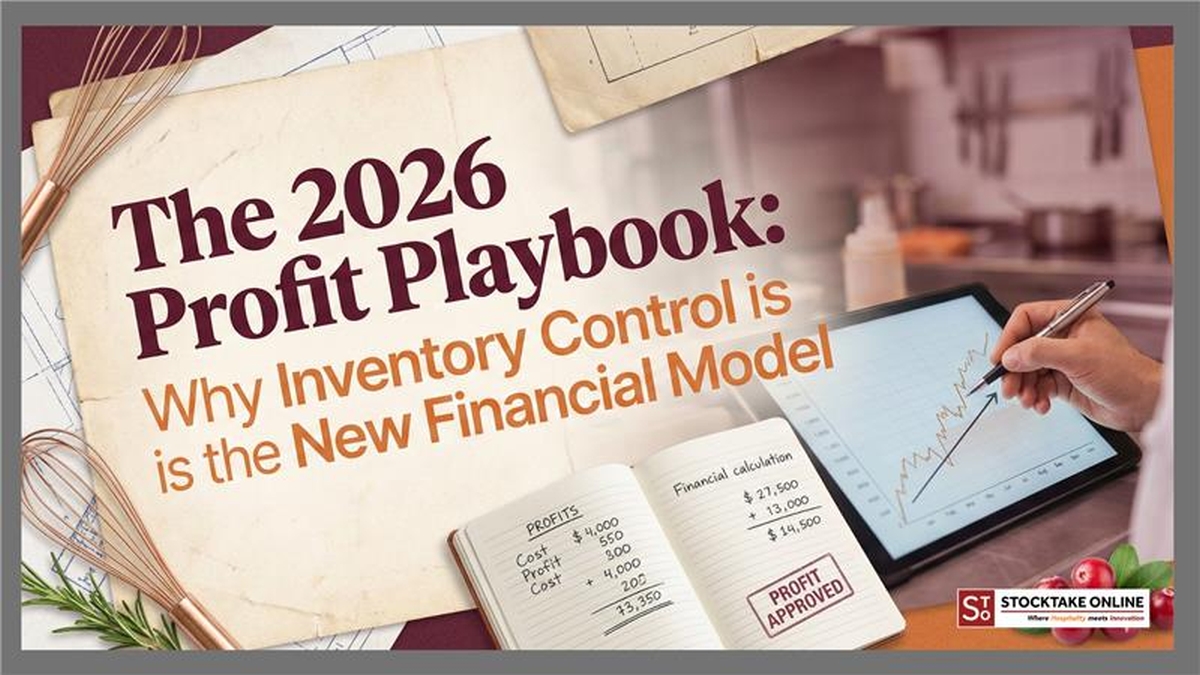
For decades, the financial model of hospitality was relatively static: drive top-line revenue, negotiate rent, and squeeze labour. Inventory was often relegated to an operational chore—something to be counted, not analysed. However, in an era of volatile supply chains and fluctuating ingredient costs, that approach is obsolete. The 2026 Profit Playbook rewrites the rules, positioning inventory control not as a back-of-house task, but as a central pillar of financial management. This article explores why the highest margins are now guarded in the stockroom, not the dining room, and how modern systems like StockTake Online are facilitating this financial revolution.
Why the Old Financial Model Cracks
For many years, hospitality profit was discussed through a simplistic lens: Increase covers, control the roster, and keep the landlord happy. In this equation, inventory was a passive variable. It was "looked at" operationally—usually to check if there was enough stock for the weekend—but rarely viewed financially until the accountant closed the books.
The cracks in this old model are now undeniable. Traditional financial management runs backwards.
- The Lag Effect: Stocks are taken at the end of the period.
- The Mirror Analysis: Margins are calculated weeks after the food has been sold.
- The Result: When the data finally gets "on paper," it is too late to act.
Reports aggregated at the end of the month act like a ship’s rudder that only works after the voyage is over. In today’s harsh economic environment, this delay is fatal. Prices of ingredients change without prior notification. Demand patterns shift weekly. Multi-site inconsistencies compound these errors silently.
Waste hides within small decisions made daily—a heavy hand on a portion, a mismanaged delivery, an unchecked invoice—accumulating fast. The "rear-view mirror" approach forces operators to spend their time correcting errors rather than preventing them. This leaves businesses "busy" in terms of covers, but grossly empty in terms of retained revenue.
Inventory Control Compared with Financial Discipline
In the context of the 2026 Profit Playbook, inventory control is no longer just about knowing the contents of the shelf; it is about understanding how cost moves through the business.
Modernised hospitality inventory connects purchasing, recipe engineering, consumption, and supplier pricing into one coherent financial signal. This allows operators to view margin risks as they form, rather than weeks later.
When inventory is elevated to a fiscal discipline, it delivers specific financial outputs:
- Granular Visibility: Insight into food cost at the individual ingredient level.
- Variance Detection: Identification of waste and theft in real-time, not post-audit.
- Dynamic Costing: Cost-per-dish data that updates according to actual supplier invoice prices.
- Commercial Confidence: The ability to run promotions knowing exactly how they impact the bottom line.
- Cash Flow Predictability: Ordering aligned strictly with demand, protecting working capital.
This is why robust inventory features are driving financial planning as much as they drive operational hygiene.
Why Inventory Is Surrounded by Guesswork Budgeting
Why do so many budgets fail? Because the base of assumptions is often wrong.
In the old model, a chef might order based on "par levels" established two years ago, or a generic percentage target (e.g., "keep food cost at 28%"). But if the price of dairy has risen by 12% and the menu price hasn't moved, that target is mathematically impossible without recipe adjustment.
Inventory control corrects these assumptions.
- Purchasing Logic: Equipment and stock should not be purchased based on last year's projection, but on consumption trends at the given time.
- Buffer Bloat: Planning moves toward actual demand rather than adding "buffer" stock, which ties up cash and increases spoilage risk.
- The Lever, Not the Cost: Inventory stops being a cost to manage and becomes a lever to be manipulated. If a margin erodes, the system flags it, and the menu or supplier order is adjusted immediately.
Where Inventory Control Really Counts: The Multi-Site Multiplier
Scale makes the financial benefits of inventory control worth multiples. However, scale also exposes the weaknesses of manual systems.
Single-site restaurants feel the pain of inflation quickly. But multi-site groups undergo the effects of such pain exponentially. A £0.05 discrepancy on a burger patty portion, or a supplier overcharging by 3% across 20 locations, adds up to enormous losses. Without a centralised hospitality inventory system, these losses remain invisible until the consolidated P&L is produced.
A unified system provides:
- One Source of Truth: A single database for ingredients and costs across all locations.
- Standardisation: Enforced recipes and portion controls that ensure brand consistency.
- Supplier Integrity: Consistent pricing and ordering logic across the group.
- Centralised Intelligence: Reporting that allows finance and operations to view data simultaneously.
- Performance Benchmarking: Faster identification of underperforming sites versus group averages.
This infrastructure is what gives growing groups the ability to scale while keeping their margins under control.
What the 2026 Profit Playbook Looks Like in Practice
Operators developing their strategy for 2026 have already gathered around a new set of principles. This is not about increased complexity; it is about greater clarity.
1. Daily Financial Decisions, Not Monthly
Inventory information fuels decisions every day. Chefs and GMs review variances daily, spotting a missed invoice or a fridge failure immediately.
2. Consumption-Driven Purchasing
Ordering is automated or guided by actual consumption data and sales forecasts, replacing "gut feeling" or old habits.
3. Real-Time Waste Recording
Waste is not a shame; it is data. Spoilage, prep waste, and plate waste are recorded in real-time, allowing chefs to adjust prep levels instantly.
4. Live Supplier Pricing
When a supplier changes a price, it is seen instantly via invoice digitisation or integration. The system immediately calculates the impact on the dish's Gross Profit (GP).
5. Unified Data for Finance and Ops
Finance teams and Kitchen Managers look at the same set of data. There is no "translation" needed between the chef's clipboard and the accountant's spreadsheet.
Why Inventory Control Is Better Than Traditional Cost-Cutting
When margins tighten, the knee-jerk reaction is often traditional cost-cutting: reducing portion sizes, switching to inferior ingredients, or cutting staff hours.
These measures are dangerous. They protect cash in the short run but hurt the guest experience and long-term stability.
Inventory control works the other way around. It locks in profit without losing quality and without service reductions. By eliminating silent waste (over-ordering, unrecorded spoilage, recipe non-compliance), the business recovers margin that was previously leaking out of the operation. This is why inventory control becomes the financial model itself, rather than simply a supporting system.
How StockTake Online Delivers the 2026 Model
This shift from reactive accounting to proactive management is exactly why StockTake Online (STO) fits into the modern hospitality stack. STO is not just a digital clipboard; it is a financial intelligence platform designed for the BOH (Back of House).
- Real-Time Variance Analysis: STO integrates with your POS to compare what was sold vs. what was consumed. This highlights the gap between Theoretical Cost and Actual Cost instantly.
- Recipe Costing & Engineering: As supplier prices fluctuate, STO automatically updates recipe costs. Operators can see if a dish has dropped below its target margin before they even open for service.
- Seamless Integration: By connecting with major EPOS and accounting platforms (see our Partner Integrations), STO eliminates manual data entry, reducing human error and freeing up labour hours.
- Multi-Site Management: For groups, STO offers head-office control over products and suppliers, ensuring that a negotiated price at the group level is honoured at the unit level.
By bringing inventory, recipes, purchasing, invoices, and variance into a real-time system, STO gives operators financial clarity before problems hit the P&L. Teams stop reacting to surprises and start managing with certainty.
Frequently Asked Questions
Why is inventory control increasingly seen as a function of finance? Because inventory directly determines food costs, cash flow, pricing accuracy, and margin stability. It is the largest variable cost in a restaurant; therefore, controlling it is a primary financial lever.
Is inventory control a substitute for financial reporting? No. It enhances financial reporting. It ensures that your P&L reports are no longer built on outdated estimates or beginning/ending inventory guesses, but rather on accurate, live consumption data.
Is this applicable only to large-scale restaurant groups? No. While large groups benefit from scale, smaller one-unit operators often see financial improvement faster because changes (like menu pricing or ordering adjustments) are less cumbersome to implement. See our Pricing to see how we scale with you.
How early can operators see financial improvement? Most operators see measurable results in cost control and waste reduction within the first four to six weeks of implementing a digital system like StockTake Online.
Will inventory control help during inflation? Yes. The visibility in pricing and usage allows operators to react before declining margins occur. If a key ingredient spikes in price, the system flags the affected recipes immediately.
Final Thoughts: The Divergence
Inventory control is no longer an afterthought in operations. In 2026, it becomes the defining financial model for successful hospitality businesses.
The divergence is clear:
- The Struggling Operator: Treats inventory as a chore, discovers losses at month-end, and cuts quality to survive.
- The 2026 Operator: Treats inventory as an intelligent system, keeps margins under control daily, and plans growth with confidence.
If inventory will shape profitability in 2026, it surely deserves tools built for that responsibility. StockTake Online helps hospitality businesses move from "maybe this will work out" to sustainable, predictable profit.
Ready to secure your margins for the year ahead? Don't wait for the next P&L surprise. Contact us today for a demo and see the new financial model in action.

|
About Stocktake Online |