



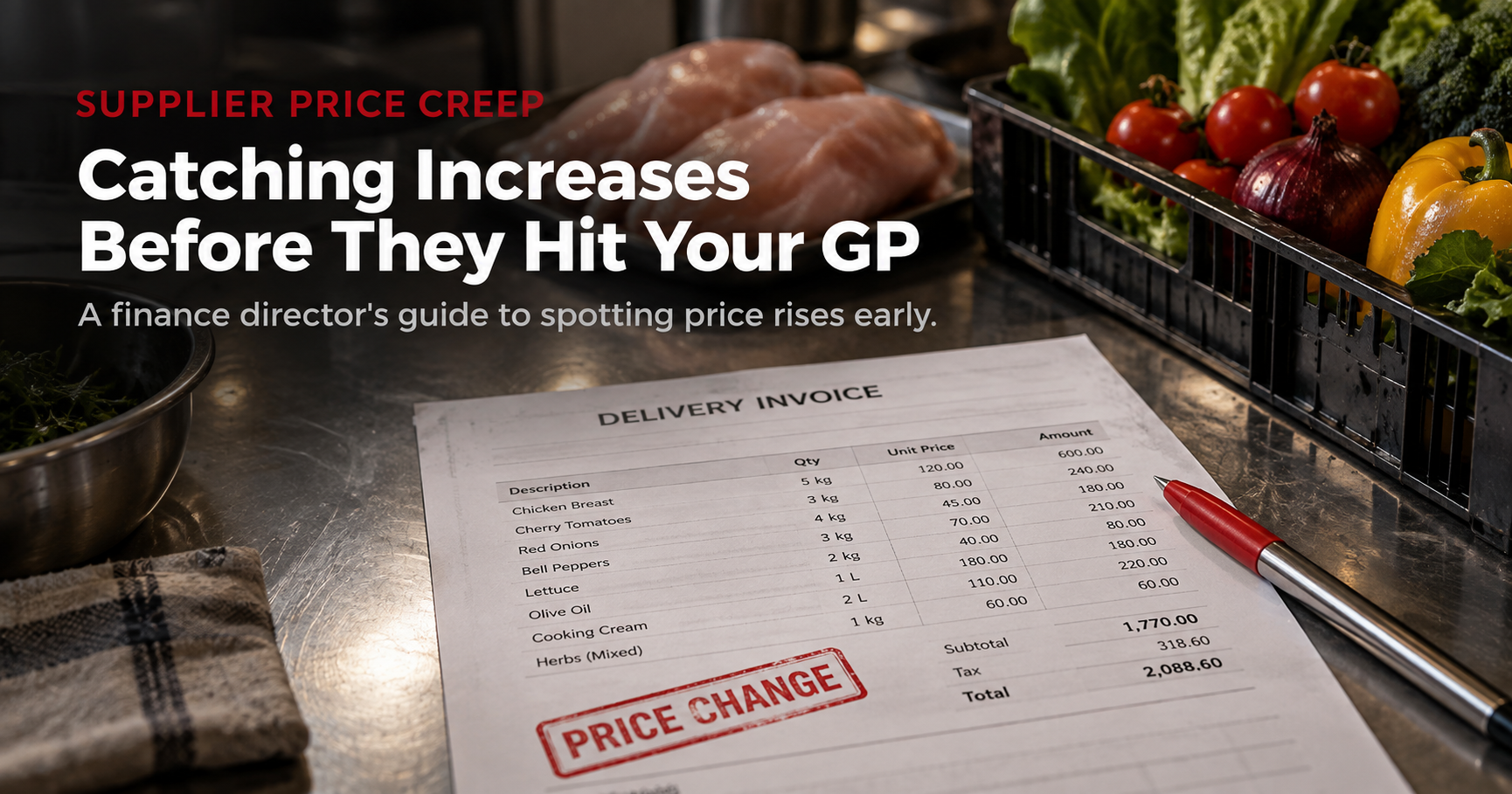
Supplier price creep is the slow, unannounced rise in ingredient and supply costs that chips away at gross profit long before anyone notices a problem. It rarely arrives as one dramatic invoice. It arrives as a few pence here, a rounding adjustment there, until a finance director reconciles the quarter and finds GP% has quietly slipped.
What Is Supplier Price Creep, and Why Does It Erode Margin Quietly?
Price creep happens when a supplier raises a unit price by a small, easy-to-miss margin and that price simply becomes the new baseline. Nobody signs off on it. Nobody flags it in a meeting. It only shows up when someone compares this month's invoice line against a price from several months ago, and by then the cost has already worked its way through dozens of deliveries.
According to the Office for National Statistics (July 2026), prices in the UK restaurants and hotels category rose 4.0% in the 12 months to July 2026, easing only slightly from 4.4% the previous month. That is a category-wide average. Individual ingredient lines, particularly proteins and dairy, often move considerably more than the headline number in either direction, which is exactly why a single annual review is not enough to catch creep as it happens.
For a finance director running multiple sites, the risk compounds. A 2% drift that goes unnoticed at one site is a rounding error. The same drift repeated across twelve sites, unflagged for two quarters, is a material line in the P&L.
What Are the Warning Signs of Price Creep in Your Invoices?
Price creep tends to follow a recognisable pattern. Five signs are worth checking for on every invoice run:
- A unit price changes without a corresponding note, credit, or supplier communication.
- The same ingredient carries a different price across sites that order from the same supplier.
- A price rise appears just after a contract renewal or a menu relaunch, when attention is elsewhere.
- Recipe costings and menu prices haven't been reviewed in the same period the supplier invoice changed.
- GP% on a specific dish drifts downward for two or more consecutive stock periods with no change in portioning or waste.
How Much Does Unnoticed Price Creep Actually Cost?
The maths behind price creep is straightforward once it's laid out. The formula finance teams use to size the exposure is:
|
Monthly cost impact = (New unit price − Baseline unit price) × Monthly volume Annualised impact = Monthly cost impact × 12 |
Illustrative example, not a client figure: a single-site kitchen buys a case of chicken breast at £45 a case, three cases a week. A supplier raises the case price by 4%, or £1.80, and nobody flags it. That's £5.40 a week, roughly £23 a month, and around £280 across a year, from one ingredient line at one site. Multiply that pattern across a full order guide of thirty or forty lines, and the annual exposure moves from a rounding error to a genuine dent in gross profit.
This is the calculation finance directors run once creep is suspected: it's a worked illustration to show the shape of the problem, not a promise of a specific outcome for any individual business.
How Do UK Restaurants Track Supplier Prices: Manual vs Automated?
Most kitchens start with a manual process and outgrow it as soon as they add a second site or a wider supplier list.
|
Approach |
Detection speed |
Consistency across sites |
Audit trail |
|
Manual invoice checking |
Weeks to a full quarter, depending on when someone reviews |
Inconsistent; depends on who is checking and how carefully |
Patchy, usually a spreadsheet someone updates when they remember |
|
Automated price-variance tracking |
Same delivery, flagged as it's processed |
Consistent, every site checked against the same baseline |
Every flagged variance is timestamped and attributable to an invoice |
Neither approach changes what a supplier charges. What changes is how quickly the business notices, and how much evidence it has when it asks for a credit or a renegotiation.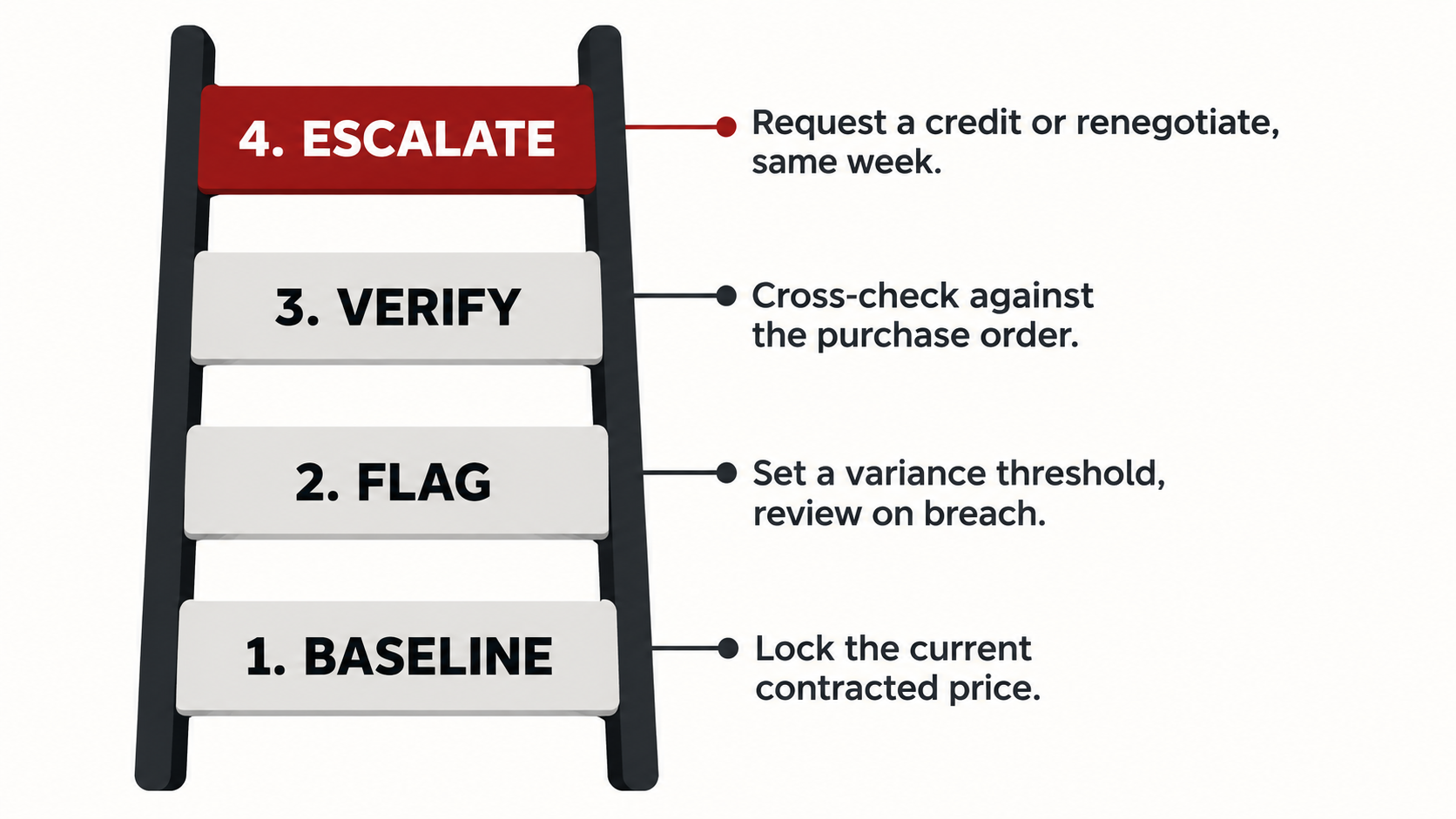
The Price Creep Ladder: A Four-Step Framework
STO's finance customers use a simple four-step method, which we call the Price Creep Ladder, to keep price rises visible instead of buried in a spreadsheet.
- Baseline: lock the current contracted or list price for every SKU as the reference point.
- Flag: set a variance threshold, commonly 3% on proteins and dairy, that triggers a review the moment an invoice line crosses it.
- Verify: cross-check the flagged line against the purchase order and any supplier price notice before assuming it's genuine.
- Escalate: raise a credit request or a renegotiation conversation with the invoice evidence attached, the same week, not the same quarter.
- Supplier price creep is a gradual, unflagged rise in cost, not a single dramatic invoice spike.
- UK restaurant and hotel prices rose 4.0% year on year to July 2026 (ONS), but individual ingredient lines can move well beyond that average.
- A simple formula (new price minus baseline price, multiplied by volume) shows the real annualised exposure of an unnoticed rise.
- Manual invoice checking is slower and less consistent across sites than automated price-variance tracking.
- The Price Creep Ladder, baseline, flag, verify, escalate, turns price monitoring into a weekly habit rather than a quarterly surprise.
- Start with the free Food Cost Calculator, then move to supplier management software once the exposure is confirmed.
One multi-site finance director summed up why this matters: “The invoice never lies, but nobody reads it line by line every week.” (Illustrative composite, not an attributed client quote.)
What Should a Finance Director Do This Week?
Start by using the free tool to check what a price rise does to your margin: the StockTake Online Food Cost Calculator shows the GP% impact of a supplier increase against your own menu prices in a few minutes, no sign-up required.
Once you can see the exposure, the next step is putting the Price Creep Ladder into a system rather than a spreadsheet. STO's supplier management software centralises every supplier price, invoice and order in one place, so a variance is flagged the day it lands rather than the quarter it's noticed.
For a fuller view of how supplier data, purchasing and recipe costing connect across a multi-site operation, see our full guide to restaurant supplier management software, which covers the wider procurement picture beyond price tracking alone.
If price creep is already showing up in your GP%, book a demo and we'll walk through automated price tracking using your own supplier list and order guide.
Frequently asked questions
What is supplier price creep? Supplier price creep is a small, often unannounced rise in an ingredient or supply price that becomes the new normal without being formally reviewed or challenged, gradually eroding gross profit.
How often should restaurants check supplier invoices for price increases? Every delivery, ideally, rather than monthly or quarterly. Automated tracking checks every invoice line as it's processed; manual checking should happen at least weekly on high-spend categories.
What's a reasonable variance threshold to flag a supplier price rise? Many UK operators use around 3% on high-volume categories such as proteins and dairy, and a slightly wider band on lower-spend, less volatile lines. The right threshold depends on your margin structure.
Can menu pricing alone offset supplier price creep? Menu pricing can help, but only once the creep has been identified. Repricing without first confirming which ingredient lines actually moved risks either under-correcting or raising prices on dishes that didn't need it.
How does StockTake Online help catch supplier price increases automatically? STO's supplier management software compares incoming invoice prices against each SKU's baseline as orders are processed, flagging variances above your set threshold so they can be reviewed the same week rather than discovered at quarter-end.