




Running inventory across several restaurants is a different problem to running it in one. As a group grows, spreadsheets, manual stock counts and site-by-site purchasing stop being a system and start being a source of risk.
Restaurant inventory management software exists to close that gap. A good platform does more than count stock. It gives operators one place to see purchasing, recipes, food cost, variance and site performance, across every location.
With dozens of vendors making similar claims, this guide sets out what UK multi-site operators should actually compare before choosing restaurant inventory management software, using seven concrete, checkable factors rather than a features list.
What Is Restaurant Inventory Management Software?
Restaurant inventory management software brings purchasing, stock counts and production into one system. For a single site, that mostly means fewer spreadsheets.
For a multi-site group, it means something bigger: one owner can see stock use and purchasing across every location, at the same time, without waiting for each site to send in a count.
Why Multi-Site Groups Need More Than a Simple Stock Count
Different sites usually have different managers, different supplier habits and different ordering patterns. Left alone, each site ends up keeping its own version of the truth, and comparing performance across the group becomes guesswork.
A centralised system should be able to answer six questions without a manual report-build:
- Which locations run the highest food cost?
- Which locations show the most stock variance?
- Are all sites ordering to the same schedule?
- Which ingredients drive the most spend group-wide?
- Are recipe costs consistent from site to site?
- How much stock moves between locations each month?
The bigger the group, the more these answers matter, and the more expensive it gets to keep chasing them by hand.
The STO 7-Point Multi-Site Fit Test
To make comparing platforms concrete rather than a features arms race, we use a simple framework internally and share it here: the STO 7-Point Multi-Site Fit Test. It scores a platform against the seven things that actually change outcomes for a multi-site UK group, not the longest feature list.
|
Factor |
What good looks like |
Why it matters for multi-site groups |
|
1. Multi-site visibility |
Group-wide and site-level reporting in the same view, without a manual roll-up. |
Head office can compare sites directly instead of stitching spreadsheets together. |
|
2. Stocktake accuracy |
A count process quick enough that teams actually complete it on schedule. |
A count nobody finishes on time produces numbers nobody can trust. |
|
3. Food cost and GP reporting |
Actual vs theoretical food cost, variance and GP side by side, by site. |
Turns inventory data into a financial answer, not just a stock list. |
|
4. Purchasing and supplier control |
One purchasing view even where sites use different suppliers or prices. |
Stops price and volume drift going unnoticed across the estate. |
|
5. Recipe and ingredient consistency |
Recipes linked to live ingredient costs, updated once, applied everywhere. |
A menu item should cost the same to make in every site running it. |
|
6. Stock transfers between locations |
A logged, trackable way to move stock between sites internally. |
Removes the guesswork over who sent what, and who should be charged. |
|
7. POS and accounting integration |
Open API or native links into the systems already in use. |
A platform that fights the existing tech stack adds work instead of removing it. |
Score a shortlist against these seven factors and the comparison stops being about who has the longest feature page.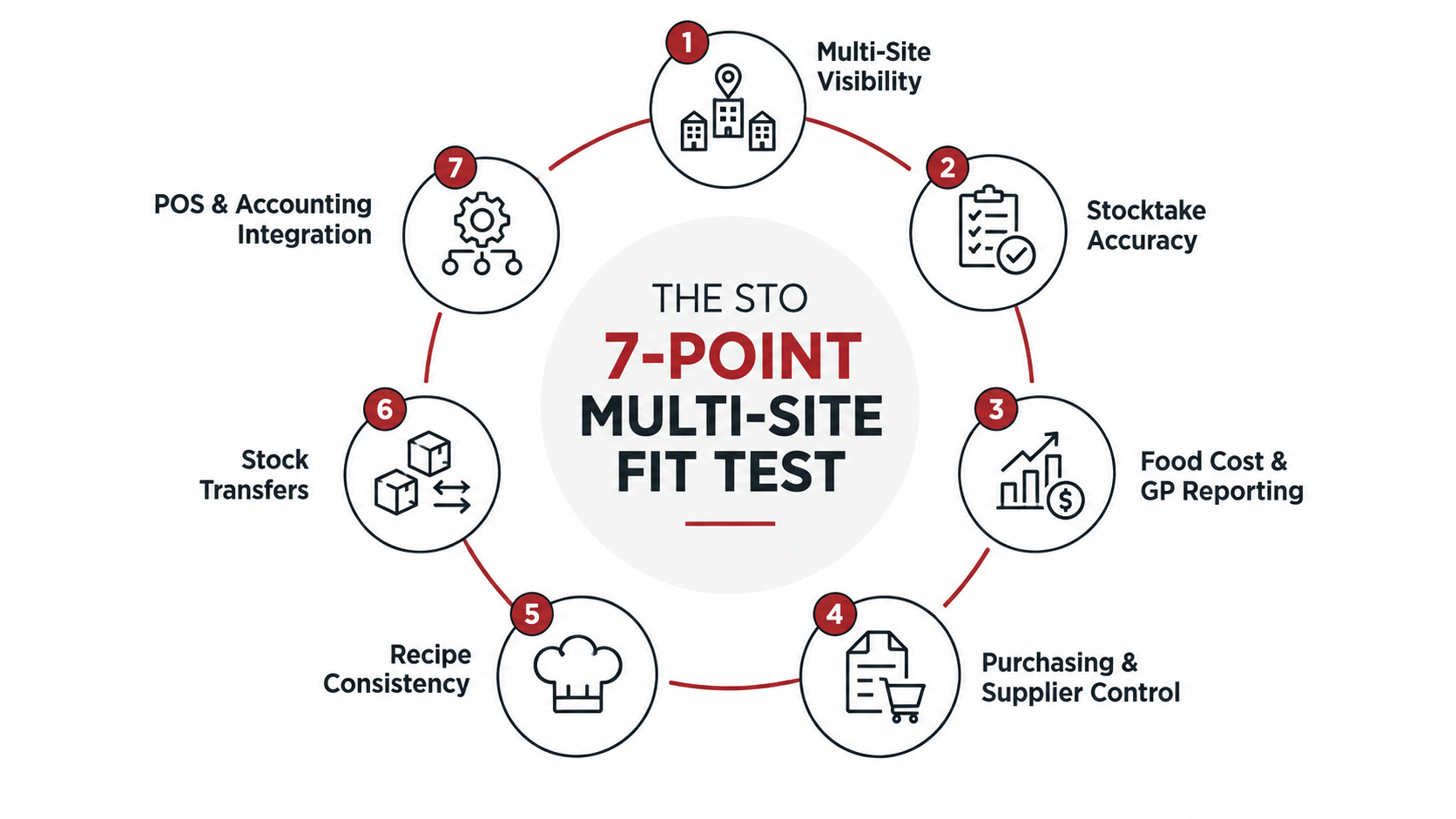
Why Scalability Should Shape the Decision Now, Not Later
Choosing software for today's site count alone is a common, avoidable mistake. A group moving from three sites to ten or twenty needs a system built for that path, not one that needs replacing halfway through it. STO's large chain and franchise management tools are built around that scaling curve rather than a fixed site count.
Scalability is not only about the number of locations. Users, reporting depth, purchasing complexity and the number of concepts under one roof all need to scale together, or the system becomes the bottleneck it was bought to remove.
What This Looks Like in Practice
|
Illustrative example: “We didn’t realise how much variance was hiding until we could see every site side by side,” notes a hypothetical multi-site operations director weighing a move away from spreadsheets. This is an illustrative scenario, not a verified client quote. |
According to the NIQ RSM Hospitality Business Tracker (May 2026), UK hospitality groups’ like-for-like sales growth has trailed the Consumer Prices Index for 13 consecutive months. That kind of margin pressure is exactly why multi-site operators cannot afford food cost and GP reporting that only surfaces problems at month-end.
How StockTake Online Supports Multi-Site Groups
StockTake Online is built for hospitality, from independent sites to multi-location groups. It brings stock control, purchasing, recipe costing, supplier management, reporting and location transfers into one enterprise dashboard, so head office can compare GP performance and variance across every site from a single screen.
Recipe costs stay consistent across every site through recipe management tools linked to live ingredient pricing, and stock moves between sites are logged through transfer between locations rather than tracked on a spreadsheet. STO integrates with POS systems including Toast, Lightspeed, Aloha EPOS, TISSL, Grafterr and HubRise, and with Xero for accounting. Operators typically identify up to 3 to 8% in recoverable food cost within the first 60 days of going live.
Use a Food Cost Calculator Before You Compare Platforms
Before comparing software, it helps to know where food cost actually stands today. STO’s free Food Cost Calculator works out the food cost and gross profit impact of a single recipe in a couple of minutes, no sign-up required. It is a fast starting point before evaluating a full platform, and one of several tools on the free tools page.
Conclusion
Picking restaurant inventory management software is not about the platform with the most features. For UK multi-site operators the real question is narrower: can this system produce accurate, comparable answers across every location, without extra manual work at head office?
Multi-site visibility, stocktake accuracy, food cost and GP reporting, purchasing control, recipe consistency, stock transfers and integrations are the seven factors worth testing before signing anything. Try the Food Cost Calculator first, look at how StockTake Online’s stock control system scores against the framework above, then book a demo to see it running against your own sites.
Key takeaways
- Score any shortlist against the STO 7-Point Multi-Site Fit Test, not a raw feature count.
- Multi-site visibility and food cost/GP reporting matter more as the estate grows, not less.
- Recipe and pricing consistency across sites protects margin that a single-site view can hide.
- Stock transfers between locations need a logged process, not an informal one.
- Scalability, not today's site count, should drive the decision.
- A free food cost calculator is a faster starting point than a features comparison.
Frequently asked questions
Which restaurant inventory management software is best for multi-site operations? There is no single “best” platform for every group. The priorities that matter most are multi-site reporting, accurate stocktakes, food cost and GP visibility, purchasing control, recipe consistency and clean stock transfers between sites.
What should restaurant inventory software include as standard? At minimum: stocktaking, purchasing, supplier management, recipe costing, food cost and variance reporting, and multi-site reporting in one system rather than several disconnected tools.
Can inventory software replace a restaurant's POS system? Generally no. Most operators keep POS and inventory as separate, integrated systems connected by API, though a small number of platforms offer limited built-in POS functionality.
How long does it typically take to see results after switching? STO operators typically identify up to 3 to 8% in recoverable food cost within the first 60 days of going live, though this depends on how consistently stocktakes were run beforehand.
Does multi-site inventory software work for a group planning to grow? It should. The right platform scales with users, sites and reporting complexity together, so a group moving from a handful of sites to twenty or more does not need to switch systems mid-growth.