


A dine-in restaurant that costs its dishes accurately knows its margin. A cloud kitchen that does the same thing knows a fiction, because the plate cost is only the first layer of what an order really costs. Packaging leaves with every order, the delivery platform takes its commission off the top, and a menu that shows a comfortable margin on paper can be trading at a loss on one channel while nobody looks. Catering has the same shape with different names: the recipe cost is only the start, and the quote lives or dies on what gets added between the kitchen and the venue.
This guide covers costing for both formats. The fundamentals, usable yields, batch preps and portion specs, are covered in standard recipe costs, yields and batch recipes; this piece assumes them and deals with what delivery and events add on top.
Why is the plate cost not the real cost in a cloud kitchen?
Because two more costs attach to every single order and neither appears on a recipe card. Packaging is a per-order ingredient in all but name: the box, the tub, the bag, the cutlery and the seals scale with volume exactly like food does, and on low-ticket items they can rival the garnish cost. Platform commission is larger still, a percentage of the selling price taken before revenue reaches you, and it differs by channel, so the same burger earns a different margin on each app and on your own website. A costing system that stops at the plate is systematically flattering every delivery item it prices.
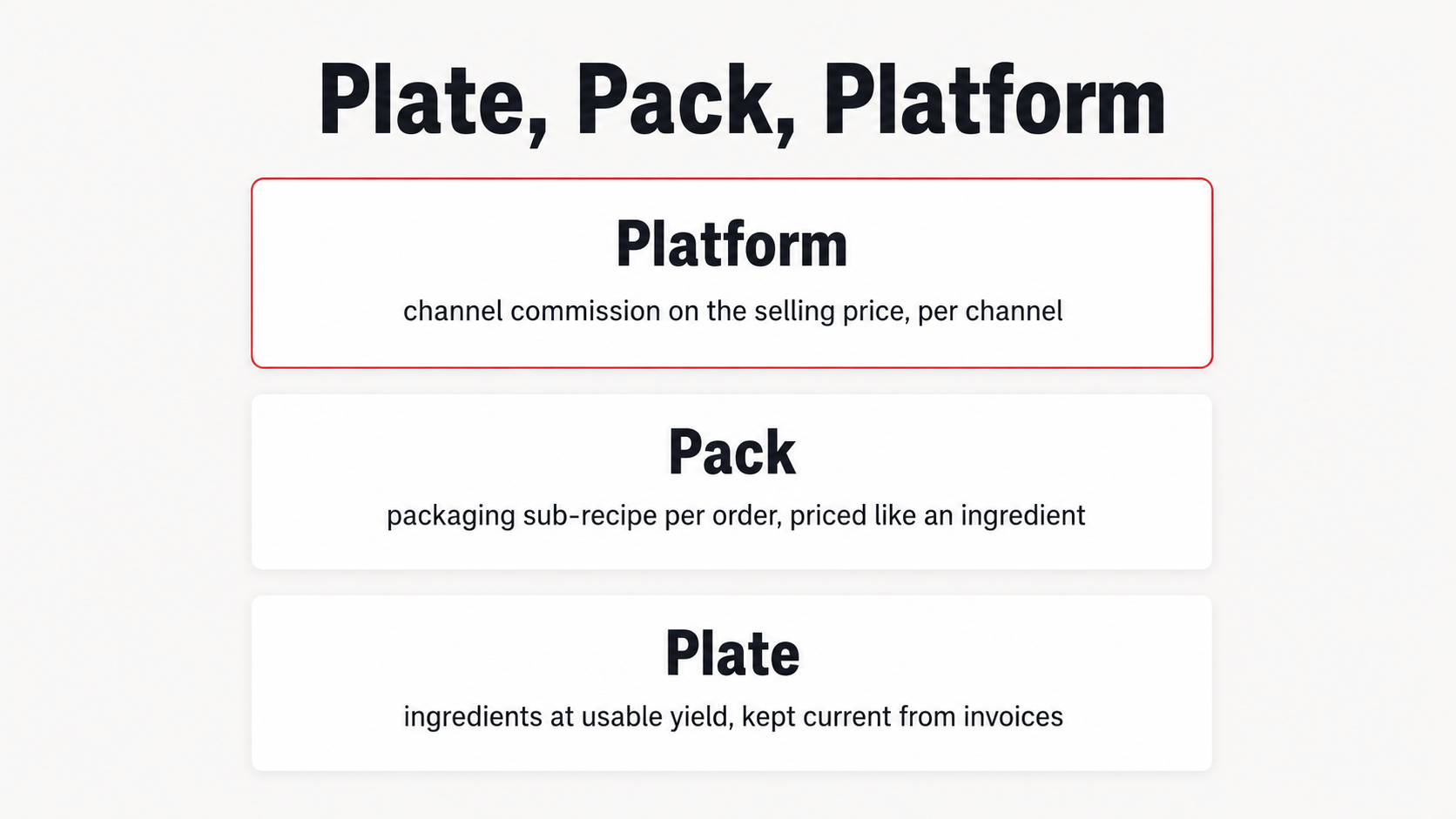
How do you cost in three layers? Plate, Pack, Platform
Cost every delivery item as a stack of three layers, and judge its margin per channel.
|
Layer |
What it contains |
How to hold it |
|
1. Plate |
Ingredients at usable yield cost, batch preps as sub-recipes, fixed portion spec |
The standard recipe card, kept current from supplier invoices |
|
2. Pack |
Primary packaging, bag, cutlery, napkins, sauce pots, seals, per order or per item |
A packaging sub-recipe attached to each delivery item, priced like any ingredient |
|
3. Platform |
Channel commission as a percentage of selling price, per channel |
A per-channel deduction on the selling price, so the same item shows one GP per channel |
Worked example (illustrative only). A delivery burger costs 2.90 pounds in ingredients at usable yields. Its packaging sub-recipe, box, bag, cutlery and dip pot, adds 55 pence: a true kitchen-door cost of 3.45 pounds. It sells at 11 pounds on an app charging an assumed 25 per cent commission, so 2.75 pounds leaves before revenue lands and net revenue is 8.25 pounds. Real gross profit is 4.80 pounds, about 58 per cent of net revenue, while the menu-price-and-plate-cost view claims nearly 74 per cent. The same item sold on the kitchen’s own site at zero commission earns 7.55 pounds. That spread, invisible to plate-only costing, is what channel pricing decisions should run on. Figures and the commission rate are illustrative to show the method, not benchmarks.
How does costing work when one kitchen runs several brands?
Virtual brands multiply menus, not kitchens: three brands can share one store, one prep list and largely one ingredient set. Cost them from one central library, with each brand’s items built from the same shared ingredients and batch sub-recipes, and two things follow. Ingredient price changes reprice all three brands at once, and brand-level gross profit becomes honestly comparable, which is how you learn that brand two’s wings menu subsidises brand three’s wraps. The same library discipline is what makes theoretical versus actual variance workable in a shared kitchen: usage is compared against the combined sales mix of every brand, so waste and portioning problems surface even though three menus draw from one shelf.
What changes for catering and events?
Catering replaces the platform layer with a journey layer, and it adds a quoting discipline. The three questions that protect an event margin: What does the menu cost per head at current prices? Batch recipes scaled to the function sheet answer that, and they must be costed at today’s ingredient prices, not the prices from when the sample menu was written. What does the journey add? Disposables, transport packaging, and any production buffer, an overage allowance for realistic plate-ups, costed in explicitly rather than absorbed silently. And what did the event actually consume? Reconciling issued stock against the function sheet afterwards turns every event into a data point that sharpens the next quote.
Off-site production runs on the same rails as central kitchens: batches made in one place, costed once, and issued to the event as transfers. Our guide to central and commissary kitchen stock control covers that movement without losing the costing.
Why does price movement hit these formats harder?
Delivery and catering margins are already compressed by the pack and platform layers, so the same ingredient movement that a dine-in menu absorbs can push a delivery item negative. The market backdrop makes the point sharper, not softer: the Office for National Statistics put food and non-alcoholic beverage inflation at 1.7 per cent in the 12 months to June 2026, the calmest annual rate since August 2024, yet individual lines still move both ways beneath that average. A cloud kitchen pricing three brands across three channels has no slack for a costing system that notices a price rise a quarter late.
Spreadsheets or software: what does the workflow difference look like?
|
Workflow step |
Manual spreadsheets |
Automated platform |
|
Channel margin view |
One blended GP built monthly; channel splits estimated |
GP per item per channel, commission netted, live |
|
Packaging cost |
Absorbed into overheads; invisible per item |
Packaging sub-recipe on every delivery item |
|
Supplier price change |
Re-keyed once per brand file, three times for three brands |
Scanned invoice reprices every brand and every event menu at once |
|
Event quote |
Costed from the sample menu’s original prices |
Batch recipes scaled to covers at today’s prices |
|
Post-event reconciliation |
Rarely done; overage unknown |
Issued stock reconciled against the function sheet per event |
How does StockTake Online run this?
The three layers are ordinary objects in the platform: recipe management holds plate recipes and packaging as sub-recipes from one central library, scanned supplier invoices keep every brand and event menu at current prices, and reporting keeps channels, brands and events separate where a blended number would mislead. It runs cloud-based from a phone or tablet with no dedicated hardware, which suits kitchens that were never designed with an office.
Start with your best-selling delivery item: run it through the free Food and Beverage Cost Calculators at plate cost, then add your packaging and net off the channel commission by hand, and compare the two margins. If the gap changes how you would price that item, Book a Demo and bring one delivery menu and one function sheet; we will build both, layer by layer, live.
Key takeaways
- The plate cost is layer one of three; packaging and platform commission decide whether a delivery item actually earns.
- Judge gross profit per channel: the same item carries a different margin on every app and on your own site.
- Run multi-brand menus from one central library so prices, preps and variance stay honest across brands.
- Quote events from batch recipes at current prices, cost the journey explicitly, and reconcile issued stock after every event.
- Compressed margins leave no slack for stale costs; automate the price feed before anything else.
Frequently asked questions
How do you cost a recipe for a cloud kitchen? Cost it in three layers: the dish at usable ingredient yields, a packaging sub-recipe covering everything that leaves with the order, and the channel commission netted off the selling price, giving a true gross profit per item per channel.
Should packaging be included in food cost? For delivery items, yes, as a costed sub-recipe attached to each item. Packaging scales with orders exactly like ingredients do, and absorbing it into overheads hides a per-order cost that pricing decisions need to see.
How do delivery platform commissions affect gross profit? Commission is taken from the selling price before revenue reaches the kitchen, so an item’s real margin is its net revenue minus plate and packaging cost. The same dish can be profitable on one channel and marginal on another at the same menu price.
How do you cost a catering menu per head? Scale batch recipes to the confirmed covers, cost them at current ingredient prices, add disposables, transport packaging and a realistic production overage, and reconcile issued stock against the function sheet after the event to sharpen the next quote.
Can one inventory system handle multiple virtual brands? Yes, and it should. One central recipe library with shared ingredients and batch preps keeps every brand repricing together, makes brand-level gross profit comparable, and lets variance run against the combined sales mix of the whole kitchen.