



Pub stocktaking works best as a short weekly loop. Count your wet stock at the same point each week, record what is physically there, compare it with what deliveries and till sales say should be there, then investigate the gaps that keep repeating. That turns a count into a margin check.
Wet stock rarely disappears in one go. It goes a measure at a time: a generous free pour at last orders, a bottle dropped mid-shift, a delivery signed for but never keyed in, beer pulled through at line cleaning with no note made. Each one looks too small to chase. Repeated every week, together they sit between the GP% you priced for and the GP% you actually bank.
This guide is for independent pub owners and general managers who want a routine they can keep. It covers what to count, how to compare, how to read variance without jumping to blame, and an honest test for when a spreadsheet stops being enough.
Why does weekly pub stocktaking beat a monthly count?
A monthly count tells you that something went wrong. A weekly count gives you a fair chance of finding out what. Instead of asking "why are we short on this gin?", you can ask "what happened to this gin since last Sunday?" That is a much easier question to answer.
Timing matters for people too. Within a week, your team still remembers the busy Saturday, the broken bottle and the round that was comped for a regular. Four weeks later, nobody does.
Margins leave little room for avoidable loss. According to the British Beer and Pub Association (5 May 2026), 161 pubs closed across England, Scotland and Wales in the first three months of 2026, almost two a day. When trading is that tight, wet stock that leaves the building without a sale matters.
If you already use a professional stocktaker or receive a periodic stocktake through your pub company, keep it. A weekly in-house check sits alongside it. It simply means you spot a problem weeks before the formal report confirms it.
What counts as wet stock in a pub?
Wet stock is every drink you buy in to sell. In most pubs that means:
- Draught beer and cider, in kegs and casks
- Bottled and canned beer and cider
- Spirits, on optics and on the back bar
- Wine, by the bottle and by the glass
- Soft drinks, mixers and post-mix
- The count and the spreadsheet regularly take most of a morning
- More than one person counts, and their numbers do not always agree
- Deliveries, invoices and stock figures live in different places
- You cannot say which lines varied last month without digging
- You find variance but rarely find the cause
- You run, or plan to run, a second site
- Count at the same time and in the same order every week
- Cover every wet stock category, including the cellar and bottle fridges
- Use one fixed method for open kegs, casks and bottles
- Record deliveries, credits, breakages and line-cleaning losses as they happen
- Check that every product is mapped to the right till button
- Compare expected stock with the physical count
- Investigate repeating or high-value gaps first
- Review the last four weeks together, not just this week
- A weekly stocktake narrows any loss to seven days, while staff still remember what happened.
- Variance is expected stock minus counted stock; it is a signal to investigate, not proof of theft.
- Consistency beats precision: same time, same order, same method for open kegs and bottles.
- Most pub variance comes from process gaps such as unlogged line cleaning, comps and till mapping.
- Software pays when counting eats your week or you cannot see which lines vary; a spreadsheet can be enough for a simple single bar.
Wet stock variance is the gap between the stock you should have and the stock you actually count. The sum behind it is simple:
|
Expected closing stock = opening stock + deliveries − sales (in units) − recorded wastage Variance = counted stock − expected closing stock |
A negative variance means product left without a matching sale or record. A positive one usually points to a counting or recording error rather than a windfall. Either way, variance is a signal to look closer, not a verdict.
How do you count draught beer and part-used bottles?
Full kegs, full casks and sealed bottles are easy. Open stock is where counts drift. For the keg or cask on the line, pick one method (weighing it, using a dip gauge, or estimating in fixed fractions) and use that same method every week. As a reference, a 50-litre keg holds about 88 pints and a nine-gallon cask holds 72 pints before line and sediment losses.
For open spirit and wine bottles, count in tenths or weigh them. Again, consistency beats precision. A slightly rough method used the same way every week shows trends. A precise method used differently each time hides them.
What is the Weekly Wet Stock Loop?
The Weekly Wet Stock Loop is the five-step routine this guide is built around: Count, Record, Compare, Investigate, Track. Each step feeds the next, and week five builds on week one.
- Count at the same point every week. Choose a fixed moment, such as after close on Sunday or before opening on Monday, and keep it. Count the same areas in the same order every time: cellar, bar, back bar, bottle fridges and any spare storage. Where you can, keep the same people on the count. If you count on a Sunday one week and a Thursday the next, the comparison loses its meaning.
- Record what is physically there, not what the records say. The whole point of a stocktake is to find out what you really have. Write down full units and part units for every line. Between counts, record every delivery, credit, return and breakage as it happens. Counting on a phone rather than a clipboard cuts out the retyping, which is where many errors creep in. StockTake Online offers a free stocktake app for exactly this stage.
- Compare expected stock with actual stock. Say your records show 12 bottles of house gin and you count 10. That is a two-bottle gap. At 25ml per measure, two 70cl bottles are 56 measures. At an illustrative £4.50 a measure, that is £252 of sales that never reached the till, from one product in one week. To check what each drink should cost you in the first place, run your serves through the free beverage cost calculator, and see how UK bars calculate pour cost for the wider picture.
- Investigate the gaps that matter. Not every small discrepancy is a problem. Start with high-value spirits and your busiest draught lines, and with anything that varies two weeks running. The usual causes in a pub are over-pouring and free pouring, beer lost at line cleaning but not logged, breakages and spillages, comps and staff drinks not rung through, short or substituted deliveries, till buttons mapped to the wrong product, counting errors, and wine or beer taken to the kitchen for cooking without a record. The aim is to find where the process fails, not who to blame.
- Track patterns over four weeks or more. One odd count says very little. Several weeks of counts say a lot. Look for the same line varying every week, gaps that grow on busy weekends, one category that is always out, and shifts in the numbers after a new starter, a change of delivery day or a line clean.
"It was never one big loss. It was the same two optics, every Saturday, for six weeks."
Illustrative example of the note a GM might write after a month of weekly counts. Not a customer quote.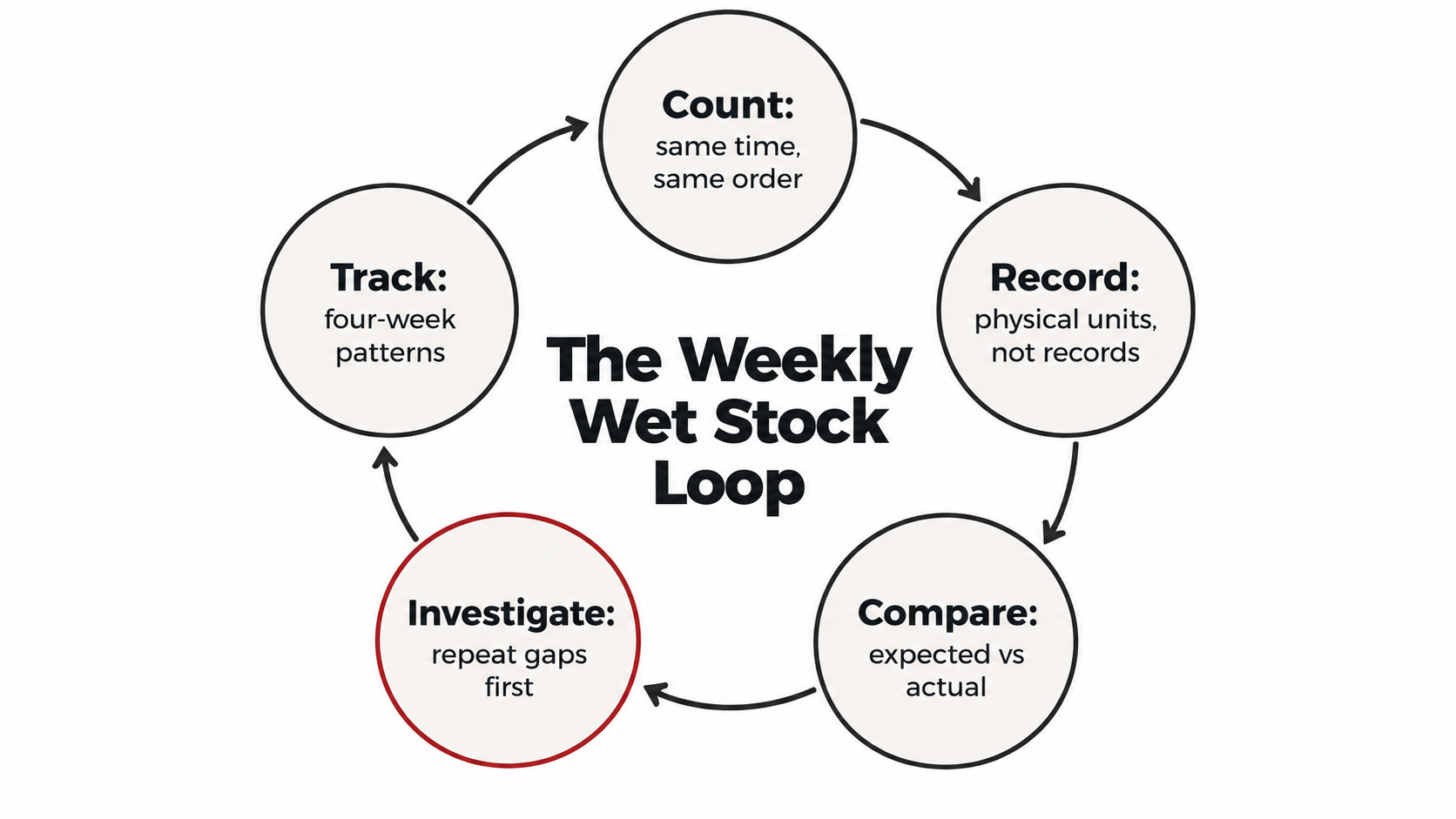
When is pub stocktaking software worth it?
For some independent pubs, a well-kept spreadsheet is enough. If you run one bar, carry a short product list and one person does the count quickly, you may not need anything else. The decision changes as the work gets heavier.
|
|
Spreadsheet and paper |
Pub stocktaking software |
|
Counting |
Paper sheets, then typed up |
Counted on a phone or tablet straight into the system |
|
Expected stock |
Manual formulas that break when rows move |
Worked out from deliveries and EPOS sales where integrated |
|
Variance view |
One sheet per week, hard to compare |
By line and category, week on week |
|
Deliveries and prices |
Invoices and stock in separate places |
Recorded against stock, price changes visible |
|
Several people counting |
Version confusion and double entry |
One shared count |
|
Best fit |
One bar, short range, one counter |
Several counters, larger range, or more than one site |
A quick test: if three or more of these sound familiar, software is likely to earn its keep.
If none of that applies and you already get timely, trustworthy numbers, keep your current method. If the count is eating your week and you still cannot see where margin goes, bar and brewery stock control software is worth a look. StockTake Online runs on any phone, tablet or browser, links with EPOS systems including Lightspeed, Aloha EPOS, TISSL and Grafterr, and reports GP%, variance and waste by line. Operators typically save up to 4 to 6 hours of senior staff time a week once counting and reconciliation move out of spreadsheets.
What should a weekly pub stock control checklist include?
Use this before your next count:
Finishing the count is not the goal. Making the numbers useful is.
Where should you start this week?
Pick your count time, walk the loop once, and write down what you find. After four weeks you will know your normal and your outliers. Start by working out what each serve should cost with the beverage cost calculator. If counting and reconciling is what is holding you back, book a demo to see pub stocktaking, wet stock variance and beverage costing in one place.
Frequently asked questions
How often should an independent pub do a stocktake? Weekly suits most independent pubs. It is frequent enough to catch problems while staff still remember the shift, and light enough to keep up. Busy wet-led venues may count high-value spirits and top draught lines more often.
What should a pub include in its wet stock count? Count draught beer and cider in kegs and casks, bottled and canned drinks, spirits on optics and the back bar, wine, soft drinks, mixers and post-mix. Include open stock using one fixed method every week.
How do you calculate wet stock variance? Work out expected closing stock as opening stock plus deliveries, minus sales in units and recorded wastage. Subtract that from your physical count. The difference is your variance for the period.
What causes wet stock variance in a pub? Common causes are over-pouring, unlogged line cleaning, breakages, comps and staff drinks not rung through, delivery errors, till buttons mapped to the wrong product and counting mistakes. Theft is only one possibility.
Do small pubs need stocktaking software? Not always. A single bar with a short range and one counter can manage well with a spreadsheet. Software tends to pay when counts take hours, several people count, or you cannot see which lines vary week to week.