



Making Tax Digital for Income Tax (MTD for ITSA) is now live for the first wave of UK sole traders and landlords, and it changes how some restaurant owners need to keep their books. If you run an independent restaurant, café or takeaway as a sole trader and your combined self-employment and property income is over £50,000, HMRC now expects digital records and quarterly updates, not an annual shoebox of receipts.
What Is Making Tax Digital for Income Tax?
According to GOV.UK (updated 2 September 2025), Making Tax Digital for Income Tax Self Assessment requires sole traders and landlords with qualifying income over £50,000 to keep digital records and submit quarterly updates from 6 April 2026, with the threshold falling to £30,000 from April 2027. Instead of one Self Assessment return a year, affected taxpayers send HMRC four quarterly summaries of income and expenses through MTD-compatible software, followed by a final end-of-year declaration.
Who Does This Actually Affect in Hospitality?
MTD for Income Tax applies to sole traders and landlords, not limited companies. Plenty of independent restaurants, cafés and single-site operators do trade as sole traders or partnerships, so this reaches a real slice of the sector. If you trade through a limited company, MTD for Income Tax does not currently apply to you: your restaurant continues filing under Corporation Tax rules. Digital, audit-ready food cost records are worth building either way, because the direction of HMRC's digital reporting agenda is well established and quarterly reporting for other business structures may follow in future.
Why Does Restaurant Inventory Data Matter for Tax Reporting?
Inventory and tax reporting are more connected than most operators assume. Your stock counts, purchase records and recipe costs feed directly into cost of goods sold, food cost percentage, gross profit and stock valuation. If invoices are logged late or a stocktake goes missing, the numbers you hand to your bookkeeper at month-end are already compromised, and every subsequent quarterly update inherits the error.
What Does Audit-Ready Food Cost Data Actually Look Like?
Audit-ready means the records exist, are consistent, and can be produced on request. In practice, that covers supplier invoices and pricing history, stocktake counts and dates, purchase to usage variance, recipe and menu costings, and a running food cost percentage rather than a single year end estimate. Organised records like these shorten month end close and make it far easier for an accountant or HMRC to verify what they are looking at.
What Are the Most Common Record-Keeping Problems in Restaurants?
Most of the friction restaurants hit with digital reporting traces back to five recurring habits:
- Paper stocktakes that get lost, delayed or mis-entered into a spreadsheet later.
- Multiple, conflicting spreadsheets across sites with no single source of truth.
- Supplier invoices logged late, inconsistently, or not matched to deliveries.
- Month-end reconciliation rushed under time pressure instead of done as you go.
- No historical record, so this quarter cannot be compared with the last.
Paper Records or Digital Inventory: Which One Is MTD-Ready?
A simple way to see the gap between the two approaches:
|
Record-keeping approach |
Update frequency |
Traceability |
MTD-readiness |
|
Paper stocktakes |
Manual, often batched at month-end |
Low: easy to lose or misfile |
Not ready: needs re-entry into digital format |
|
Multiple spreadsheets |
Irregular, inconsistent across sites |
Medium: exists, but easy to duplicate or conflict |
Partially ready: needs consolidation |
|
Digital inventory platform |
Real-time, as stock moves |
High: dated, centralised, exportable |
Ready: quarterly figures available on demand |
What Is the STO Audit-Ready Ladder?
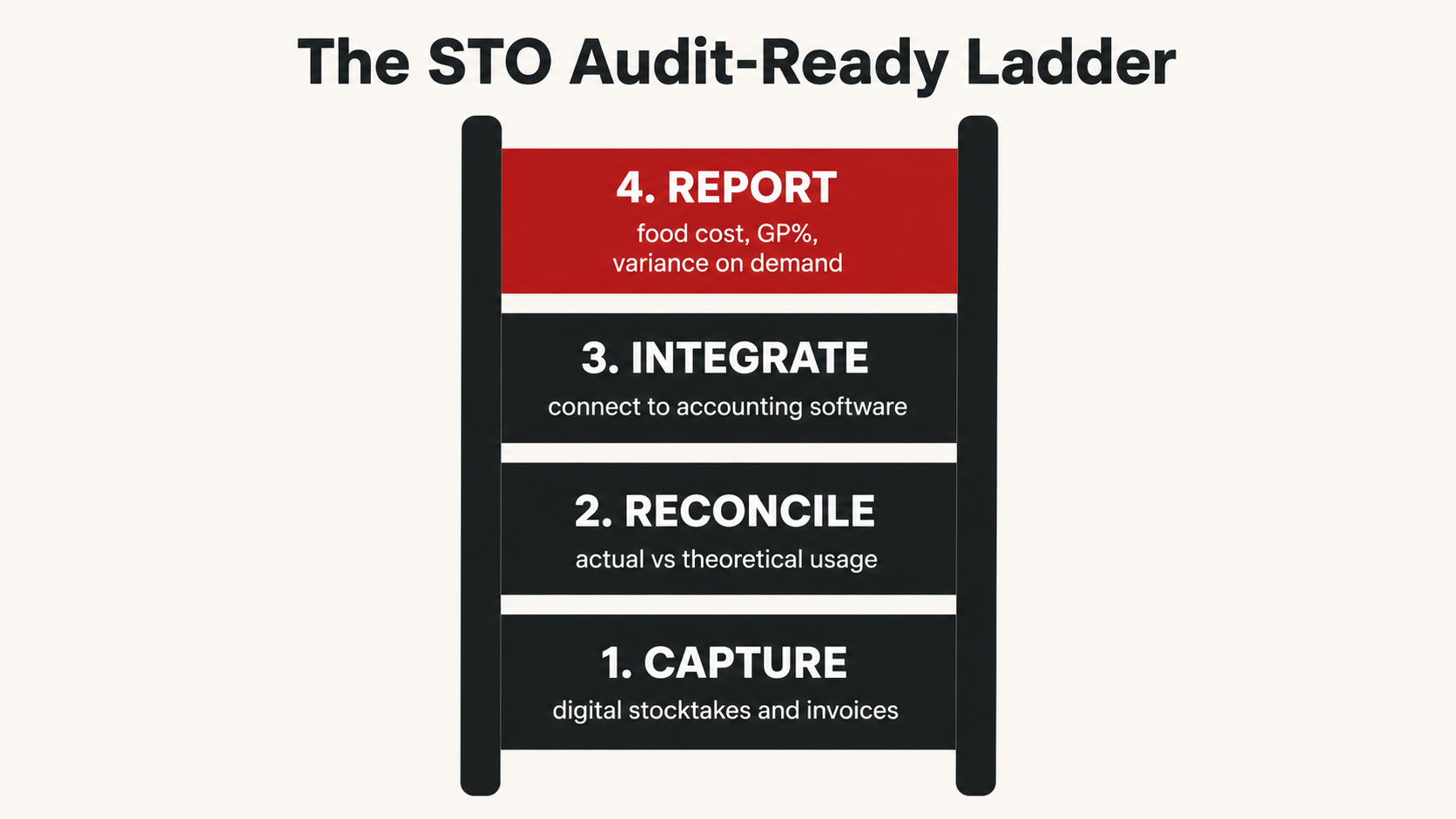
StockTake Online frames MTD-readiness as a four-step ladder, moving from raw data capture to a report HMRC or your accountant can use directly:
- 1. Capture: Log stocktakes and supplier invoices digitally as they happen, not retrospectively at month-end.
- 2. Reconcile: Compare actual stock against theoretical usage on a regular cadence, not just once a quarter.
- 3. Integrate: Connect inventory data to your accounting software, for example a Xero integration, so figures do not need re-keying by hand.
- 4. Report: Pull food cost, GP% and variance reports on demand instead of rebuilding them from scratch each quarter.
- MTD for Income Tax is mandatory from 6 April 2026 for sole traders and landlords with qualifying income over £50,000, dropping to £30,000 from April 2027.
- It applies to sole traders and landlords, not limited companies, which continue under Corporation Tax rules.
- Audit-ready food cost data means consistent, dated, exportable records: invoices, stocktakes, variance and recipe costings.
- Paper stocktakes and scattered spreadsheets are the two most common reasons month-end reconciliation runs late.
- A connected system, from digital stocktake through to your accounting software, turns quarterly reporting into an export rather than a scramble.
|
Illustrative scenario, not a StockTake Online client testimonial: “Our bookkeeper used to chase us for stock invoices every quarter close. Now the data's already there when she asks for it.” — independent restaurant owner, London. |
How Does StockTake Online Support MTD-Ready Reporting?
StockTake Online will not file your tax return, but it closes the gap between what happens on the shop floor and what your accountant needs at quarter-end. The free Food Cost Calculator is a no-signup way to see how a single recipe's costing works before you commit to a full platform. From there, StockTake Online's restaurant reporting and analytics gives you live food cost percentage, variance and gross profit reporting instead of a month-end scramble, and the Xero integration keeps purchase and inventory data lined up with your books. Operators using StockTake Online typically identify up to 3 to 8% in recoverable food cost within the first 60 days of going live, on top of the reporting benefit. See more on the science of restaurant food cost calculation if you want the underlying formulas.
If MTD for Income Tax applies to you, the deadline does not move. Book a Demo to see how StockTake Online fits alongside your accountant's software.
Frequently asked questions
What is Making Tax Digital for Income Tax? It is HMRC's system requiring sole traders and landlords with qualifying income over £50,000 (falling to £30,000 from April 2027) to keep digital records and send quarterly updates instead of a single annual Self Assessment return, effective from 6 April 2026.
Does Making Tax Digital apply to my restaurant if it's a limited company? No. MTD for Income Tax applies to sole traders and landlords. Limited companies continue to file under Corporation Tax rules, which are not currently covered by this measure.
What counts as audit-ready food cost data? Organised, dated records that can be produced on request: supplier invoices, stocktake counts, purchase-to-usage variance, recipe costings and a running food cost percentage, rather than a single figure reconstructed at year-end.
Can inventory management software replace my accounting software? No, and it is not meant to. StockTake Online handles stock, recipe costing and variance; MTD-compatible accounting software such as Xero handles the actual tax submission. The two work side by side.
Does StockTake Online integrate with Xero? Yes. StockTake Online offers a Xero integration so purchase and inventory data can flow through to your accounting records without manual re-entry.