



Food cost percentage falls when you fix the four things that create it, in the right order. Most operators start at the end, raising menu prices, and the number barely moves. The order matters more than the effort.
This guide sets out a method you can run inside one trading week. It is written for UK operators working in GP% rather than prime cost, and it assumes you have no new software in place yet.
Why does raising menu prices rarely fix food cost percentage?
Because food cost percentage is a ratio, and a price rise only changes the denominator. If your kitchen is losing product through inaccurate counts, uncosted recipes, quiet supplier increases and unexplained variance, a price rise absorbs that loss rather than removing it. You end up with the same leak and a less competitive menu.
Input costs also move underneath you. According to the Office for National Statistics (June 2026), food and non-alcoholic beverage prices rose by 1.7% in the 12 months to June 2026, the lowest annual rate since August 2024. Slower headline inflation is not the same as stable purchasing. Individual lines still move sharply in both directions, and a single supplier increase on a high-volume ingredient can undo a menu-wide price rise on its own.
The Four Locks Method
Every point of food cost percentage leaks through one of four gaps. Close them in sequence, because each lock depends on the one before it. Costing recipes against inaccurate stock data produces confident numbers that are wrong.
1. Lock one, the count. Fix how stock is counted before anything else. Same order, same units, same people, same day of the week.
2. Lock two, the recipe. Cost every dish to sub-recipe level, including yield and trim loss, so you know what each plate should cost.
3. Lock three, the price. Track supplier price movement weekly, at order stage rather than at invoice stage.
4. Lock four, the variance. Compare theoretical against actual cost and work the biggest gap first.
The method is deliberately sequential. Operators who jump to lock four first end up chasing a variance figure they cannot trust, because it was calculated from a bad count.
Lock one: how do you make a stock count accurate?
An inaccurate count corrupts every number that follows it. Three changes fix most of it.
• Count in a fixed physical order and never vary it. Walk the same route through the same zones every time.
• Standardise units before you standardise anything else. One line counted in kilograms and another in cases will produce a plausible total and a wrong one.
• Count at the same point in the trading week, ideally before a delivery rather than after one.
Counting on paper and typing it up later introduces a second chance to make an error. Counting directly into a phone or tablet removes that step entirely, which is the practical reason most operators move off spreadsheets.
If you want to see what your dishes actually cost before you change anything, the free food cost calculator will give you a per-dish figure in a few minutes with no account required.
Lock two: what does costing a recipe properly involve?
A recipe cost is not a list of ingredient prices added together. It has to account for yield, trim, sub-recipes and portion size, or it will understate the true plate cost consistently.
Take a braised dish that uses a stock made in-house. If the stock is treated as free because nobody costed it, every plate carries an invisible cost. Multiply that across a menu and the gap between your theoretical and actual food cost becomes structural rather than accidental.
Illustrative example, not an attributed client figure: a kitchen costing a 180g cooked portion against a 180g raw purchase price will understate that dish by whatever the cooking loss is. On a braise losing around a third of its raw weight, the real ingredient cost is meaningfully higher than the sheet says.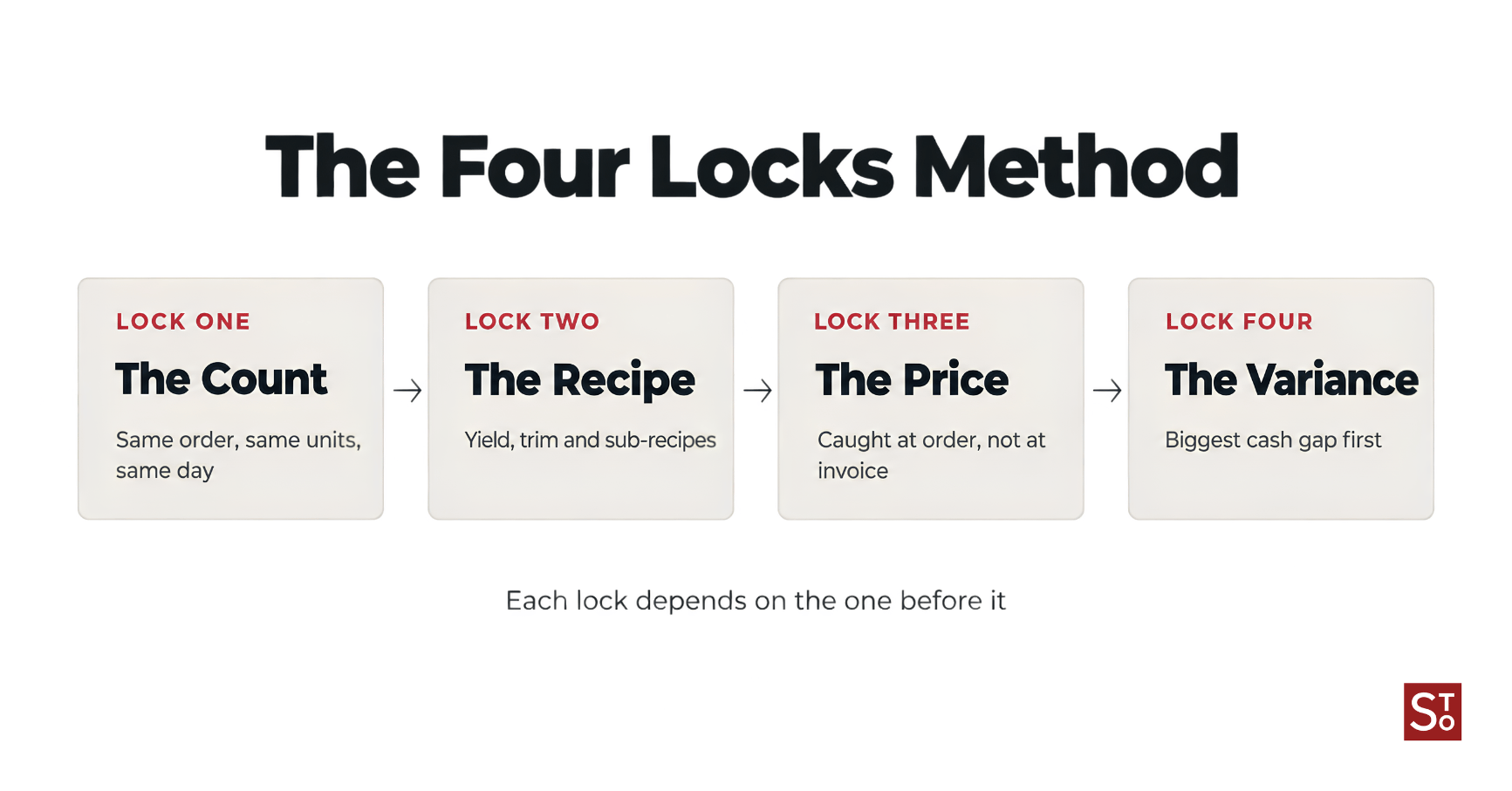
Lock three: how do you catch supplier price increases in time?
Most price increases are discovered at invoice stage, after the stock has been received, prepped and in many cases sold. By then the margin has already gone.
Catching movement earlier means checking prices at the point of ordering rather than the point of paying. In practice that means keeping a live price list per supplier and flagging any line that moves beyond a set threshold, so the increase becomes a decision instead of a surprise.
Price tracking sits alongside stock control rather than separate from it, which is why it lives inside a restaurant stock control system rather than in a separate purchasing spreadsheet.
Lock four: what is variance and how do you act on it?
Variance is the gap between what your recipes and sales say you should have used, and what you actually used. Theoretical cost minus actual cost. It is the single most useful number in back-of-house, and it only becomes trustworthy once locks one to three are closed.
Work the largest cash gap first, not the largest percentage gap. A two percent variance on your highest-volume protein is worth more than a twenty percent variance on a garnish.
Where does food cost percentage actually leak?
|
Leak point |
What it looks like on the floor |
Which lock closes it |
|
Counting error |
Totals that swing without an operational reason |
Lock one, the count |
|
Uncosted sub-recipes |
Stocks, sauces and prep treated as free |
Lock two, the recipe |
|
Yield and trim loss |
Costing raw weight against cooked portions |
Lock two, the recipe |
|
Portion drift |
Same dish, different plate cost by shift |
Lock two, then lock four |
|
Quiet supplier increases |
Margin falls with no menu or volume change |
Lock three, the price |
|
Unrecorded waste |
Stock gone with no sale and no waste entry |
Lock four, the variance |
|
Untracked transfers |
Product moved between sites off the record |
Lock four, the variance |
What should you expect after closing the four locks?
Operators using StockTake Online typically identify up to 3 to 8% in recoverable food cost within the first 60 days of going live. That is a range rather than a promise, and it depends heavily on the starting point: a site already counting weekly and costing recipes will find less than one running on memory and a clipboard.
The more useful test is behavioural. Ask whether the system changed a decision this week. A recipe re-priced, a supplier increase challenged, a portion tightened. If nothing changed, the number is being reported rather than used.
For the finance-side view of the same problem, our CFO guide to protecting gross profit covers how these four locks show up in the P&L, and the guide to calculating food cost percentage covers the underlying formula in full.
If you would rather see the four locks running against your own numbers, book a demo and bring one week of stock counts with you.
Key takeaways
• Food cost percentage falls when you close four gaps in order: count, recipe, price, variance.
• Raising menu prices changes the ratio without removing the leak.
• An inaccurate count invalidates every number calculated after it, including variance.
• Recipe costs must include yield, trim and sub-recipes or they will understate plate cost permanently.
• Catch supplier price movement at order stage, not at invoice stage.
• Work the largest cash variance first, not the largest percentage variance.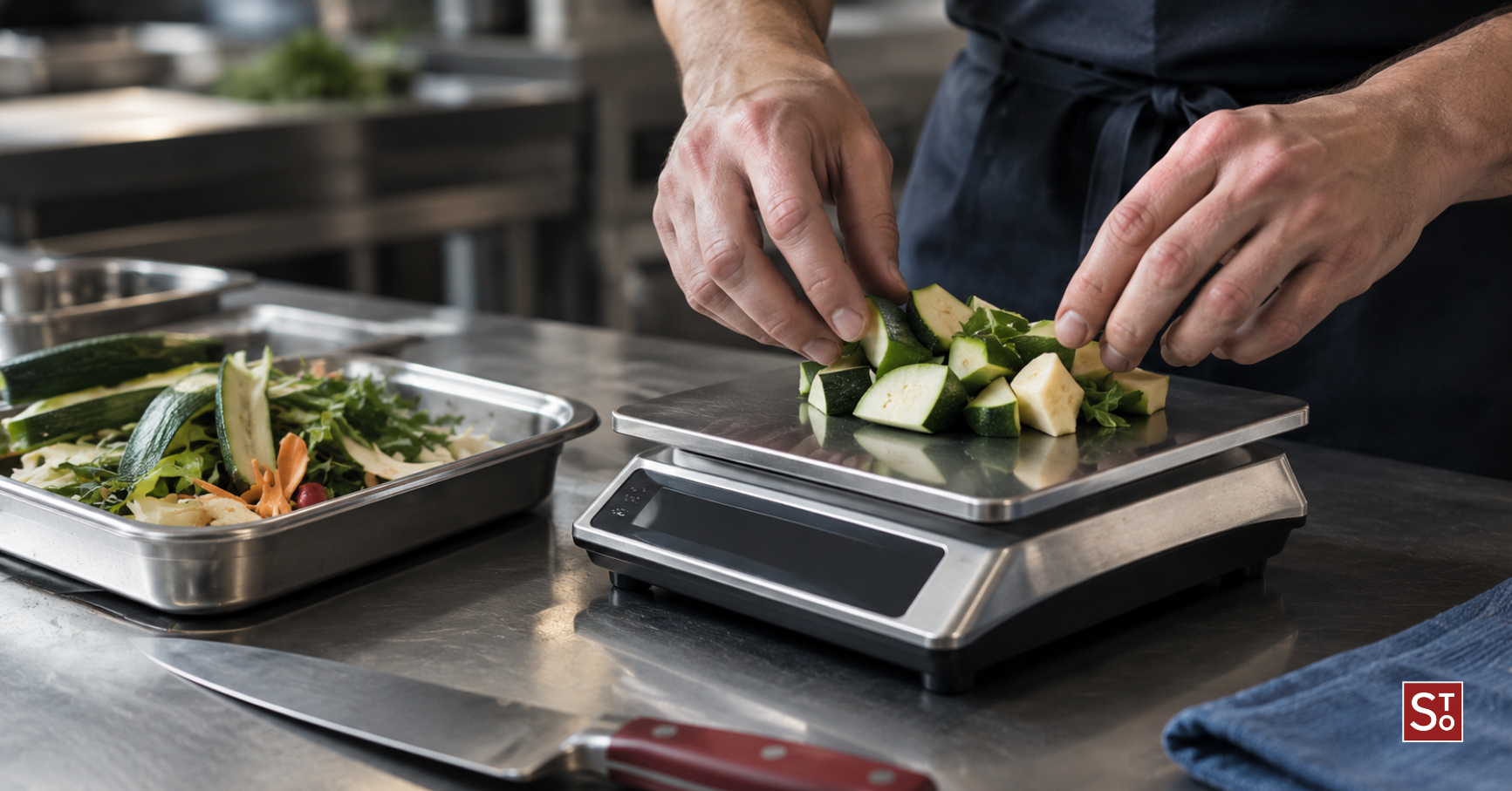
Frequently asked questions
What is a good food cost percentage for a UK restaurant? There is no single correct figure. As a rule of thumb rather than a sourced benchmark, many UK full-service operators work toward a food cost percentage somewhere in the high twenties to mid thirties, but a wet-led pub, a bakery and a fine dining kitchen will each sit in a different place legitimately. The number that matters is your own trend, not the sector average.
How quickly can food cost percentage improve? Lock one and lock two can be closed inside a fortnight in most single sites. Locks three and four need a few weeks of clean data before the variance figure is trustworthy. Operators typically identify up to 3 to 8% in recoverable food cost within the first 60 days.
Do I need software to reduce food cost percentage? No, but the four locks are much harder to hold in place manually. Spreadsheets handle a single count well and struggle with sub-recipes, yield, weekly price movement and multi-site comparison at the same time. Most operators move when the spreadsheet stops being the bottleneck and starts being the risk.
Should I reduce portion sizes to cut food cost? Only after the four locks are closed. Portion reduction is visible to guests and is the least recoverable lever you have. Counting accuracy, recipe costing and supplier price control are invisible to guests and usually release more margin.
How often should I count stock? Weekly is the practical standard for most UK sites, with high-value and high-volume lines counted more often. Monthly counting is enough for accounts but too slow to change a decision while it still matters.