



For any restaurant, hotel, cafe or other food business, allergen information is not just another menu detail. It needs to be accurate, accessible, and kept current as ingredients, suppliers and recipes change.
The Food Standards Agency (FSA) requires food businesses to give customers allergen information about the food and drink they sell, and to manage allergens properly during preparation. A restaurant inventory management system can support that requirement by keeping the record straight in one place.
This article sets out what your inventory system should hold, how it connects to Natasha's Law and PPDS labelling, and how to check whether your current process is doing the job. If you want to see how allergen tracking sits inside a wider recipe and stock system, StockTake Online's recipe management software links allergen data directly to the recipes and ingredients it comes from.
Why Do Allergen Records Matter?
Allergen information changes whenever you change a sauce, a supplier or a recipe. Swap one sauce for another and the allergens in that dish change with it. If your recipe information is not updated at the same time, the information given to customers stops being accurate.
The FSA expects food businesses to have a proper process for managing allergens, plus staff training on how that process works. An inventory system helps because it keeps ingredient, recipe and allergen data together in one place, rather than spread across separate documents.
What Are the 14 Regulated Allergens Under UK Law?
UK food law lists 14 allergens that must be declared to customers whenever they are used as an ingredient. The FSA's guidance also makes clear that this extends to relevant additives, processing aids and other substances carried through into the finished product.
|
Allergen |
Allergen |
Allergen |
|
Celery |
Cereals containing gluten |
Crustaceans |
|
Eggs |
Fish |
Lupin |
|
Milk |
Molluscs |
Mustard |
|
Peanuts |
Sesame |
Soybeans |
|
Sulphur dioxide and sulphites |
Tree nuts |
|
What Ingredient-Level Allergen Information Should You Keep?
Effective allergen management starts at the level of the individual ingredient, not the finished dish. Your system should be able to show the allergen profile for every ingredient you use, which matters most when one ingredient appears across many recipes.
Held this way, a single ingredient change can be reviewed once against every dish it touches, rather than working back through recipes one by one.
What Happens When You Change Suppliers or Ingredients?
A supplier change needs the same scrutiny as a menu change, because a replacement product can carry a different allergen profile to the one it replaces. Allergen management works best when it is linked directly to purchasing, inventory and recipe data, so a substitution cannot pass through unreviewed.
How Do Recipe and Menu Records Support Allergen Compliance?
Recipes are what connect individual ingredients to the dishes a customer actually orders. Your system should hold, for every dish: the recipe, its ingredients, quantities, preparation components, any batch recipes, and the resulting allergen information.
When a recipe changes, its allergen information should update at the same time, in the same place, rather than as a separate step that is easy to forget.
Building the update into a routine
A workable sequence looks like this:
1. Supplier update
2. Ingredient record check
3. Recipe check
4. Allergen information check
5. Staff update
Giving the team a fixed routine like this, rather than leaving it to individual judgement, is the difference between a process that holds and one that quietly drifts out of date.
How Do Recipe or Preparation Changes Affect Allergen Information?
Allergen information is not only about ingredients bought in from a supplier. The recipe and the cooking method matter too. A sauce, dressing, garnish or batch-preparation step can introduce an allergen that was not part of the original dish.
Keeping preparation methods and batch recipes in the same system as the rest of your allergen data gives a fuller, more accurate picture of what a menu item is actually made of.
Can Every Staff Member Access Allergen Information?
Accurate records are only useful if the people who need them can get to them. The FSA holds food businesses responsible for giving customers allergen information, which means staff need to be trained and equipped to provide it.
In a fast-moving service environment, that means allergen information has to be easy for staff to reach in the moment, not buried in a folder. Digital records reduce reliance on outdated spreadsheets and paper sheets that nobody remembers to update.
What Do PPDS Food and Natasha's Law Require?
Food businesses producing prepacked for direct sale (PPDS) food face stricter requirements. The FSA states that PPDS food must carry the product name and a full ingredients list, with allergens emphasised within that list. This requirement has applied since 1 October 2021.
PPDS food means food that is packed on the same premises where it is offered for sale, before the customer selects or orders it. Knowing which of your products fall under PPDS, and keeping the right information for each, is worth checking directly against current official guidance, since the detail varies by food type and how it is sold.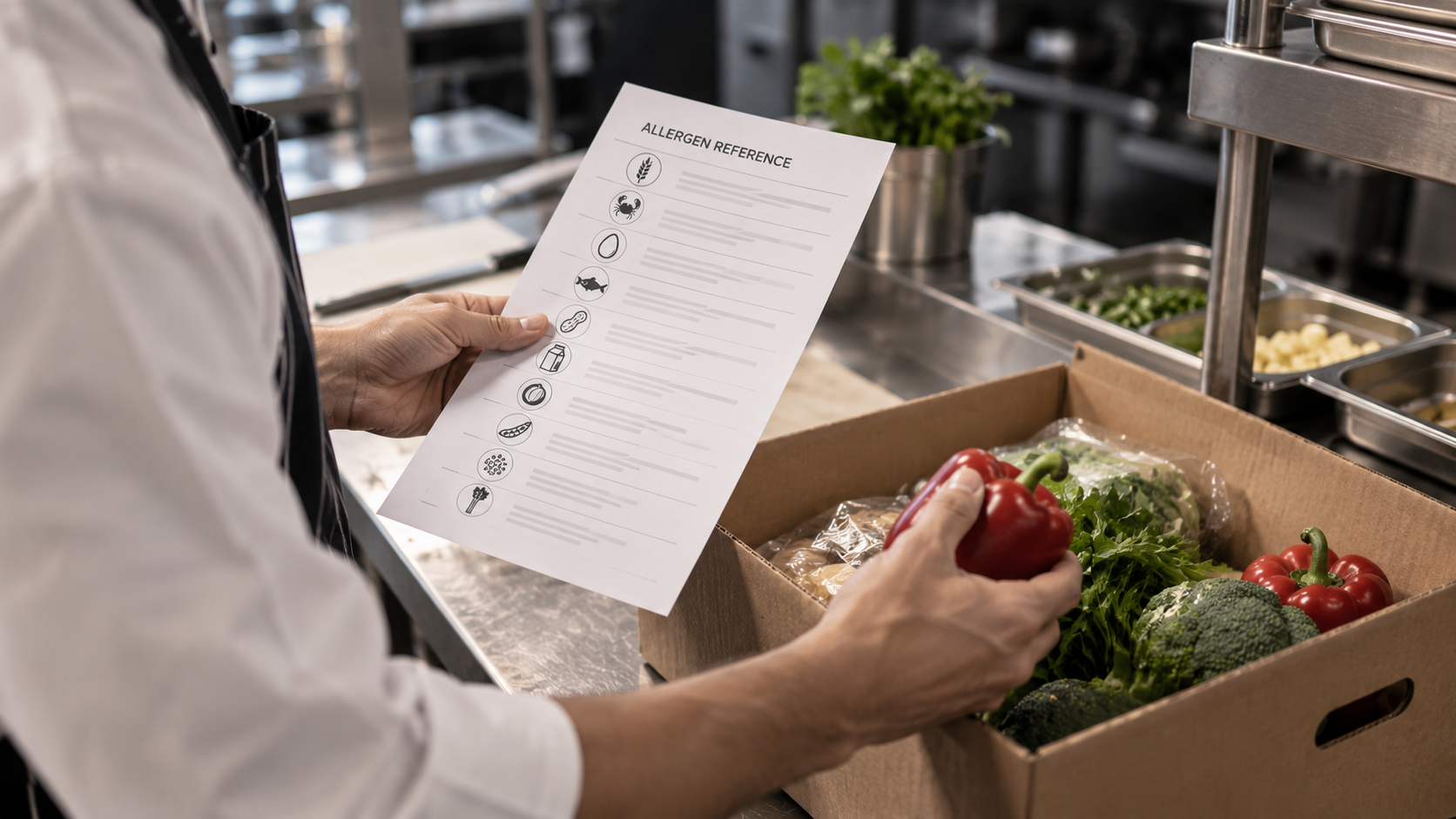
How Can an Inventory System Help You Keep Allergen Records?
An inventory system does not replace food safety procedures, staff training or compliance controls. What it can do is sit at the centre of the operational data those processes rely on.
The StockTake Online inventory platform tracks allergens at the recipe level, so hospitality businesses can connect their allergen data to the same inventory and recipe records they already use to manage stock. That is most useful where a business is running multiple recipes, ingredients, preparation batches or locations, because it keeps allergen information sitting alongside the operational data you are managing anyway.
The same logic extends to purchasing. When allergen management is connected to supplier management, a substitution at the point of delivery is more likely to trigger a review before it reaches a recipe, rather than being caught after the fact.
As one hospitality compliance consultant put it (illustrative, not an attributed client quote): "The allergen problem is never the day you get it wrong. It is the eighteen months before that, when nobody could say for certain what had changed."
The STO Allergen Trail: an original framework for this article
The five-step update sequence above (supplier, ingredient, recipe, allergen check, staff) is the backbone of what this article calls the STO Allergen Trail: a fixed path that every ingredient or recipe change should travel down before it reaches a customer. The shorter that trail, and the fewer manual hand-offs it has, the less room there is for an allergen record to fall out of date.
Manual Records or a Connected System: What Actually Changes?
The table below sets out where manual, paper-based allergen record keeping tends to break down, and what changes when the same information sits inside a connected inventory system instead.
|
Stage |
Paper folders and spreadsheets |
A connected inventory system |
|
Ingredient data |
Held per-document, easy to miss when an ingredient is reused across dishes |
Held once at ingredient level, linked to every recipe that uses it |
|
Supplier change |
Relies on someone remembering to check the new product |
Flags the affected recipes for review at the point of purchase |
|
Recipe or prep change |
Requires manually updating every printed copy in circulation |
Updates the allergen record everywhere the recipe is referenced |
|
Staff access |
Depends on a physical folder being in the right place |
Available on any device, kitchen or front of house |
|
Audit trail |
Rarely exists in a reviewable form |
Change history recorded automatically |
What Should Be on Your Allergen Record-Keeping Checklist?
Before relying on your current process, check whether your team can honestly answer yes to each of the following.
- Are allergen details recorded for every relevant ingredient?
- Are recipes linked directly to their ingredients?
- Are allergen records updated whenever a recipe changes?
- Are supplier substitutions reviewed before they reach a recipe?
- Are preparation and batch recipes recorded, not just the final dish?
- Can authorised staff access up-to-date allergen information when they need it?
- Is there a defined procedure for reviewing changes?
- Are PPDS products correctly identified, where relevant?
- Are staff trained appropriately on allergen procedures?
- Are allergen records reviewed on a regular schedule?
- Allergen records need to move at the same speed as ingredient, supplier and recipe changes, not sit as a document reviewed occasionally.
- UK law lists 14 regulated allergens that must be declared wherever they appear as an ingredient, including in additives and processing aids.
- PPDS food carries stricter labelling duties under rules that have applied since 1 October 2021.
- Allergen data held at ingredient level, and linked to every recipe that uses it, is easier to keep accurate than allergen data held per dish.
- An inventory system supports allergen record keeping; it does not replace staff training or food safety procedures.
Several "no" answers on this list is a reasonable signal that your allergen record-keeping process needs attention.
Frequently Asked Questions
What are the 14 allergens in UK food law? The 14 regulated allergens are celery, cereals containing gluten, crustaceans, eggs, fish, lupin, milk, molluscs, mustard, peanuts, sesame, soybeans, sulphur dioxide and sulphites, and tree nuts.
Do restaurants have to provide allergen information? Yes. UK food businesses must provide allergen information wherever any of the 14 regulated allergens is used as an ingredient.
What does Natasha's Law require? Natasha's Law requires PPDS food to carry the product name and a full ingredients list, with allergens emphasised, and has applied since 1 October 2021.
Should allergen data be linked to recipes? Yes. Linking allergen data to recipes makes it far easier to see which dishes are affected whenever an ingredient changes.
Can an inventory system replace allergen training? No. A digital system supports record keeping and access to information, but food safety processes and staff training remain a legal requirement in their own right, as the FSA makes clear.
Sourced statistic
According to the Food Standards Agency (food.gov.uk, Food Hypersensitivity Area of Research Interest, live-verified 16 September 2026), food allergies affect between one and two per cent of the UK population, alongside a substantially larger group managing intolerances, which is why consistent, system-wide allergen records matter at any scale of operation.
|
Interested in seeing how StockTake Online can help with allergen and inventory management? |