



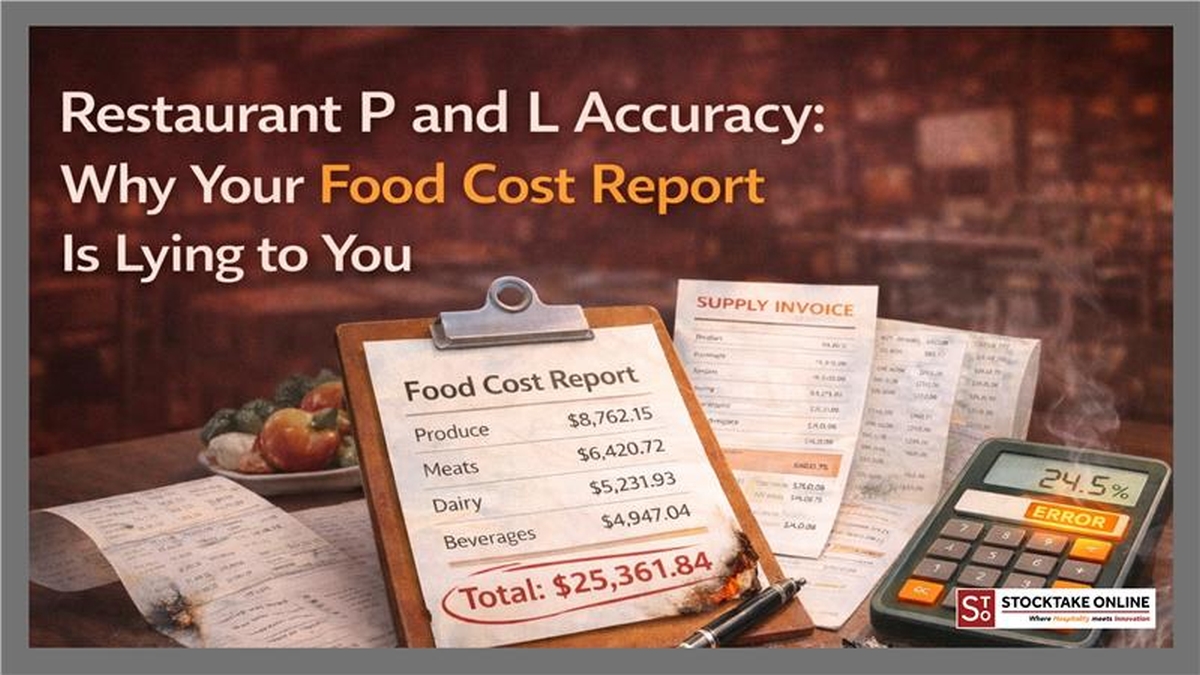
Fixing Restaurant P&L Inaccuracy with Food Cost Control Software
You open your month-end profit and loss statement and see a food cost percentage that is three points higher than your target. You know your menu prices are correct and your sales were strong, yet the numbers suggest a significant loss in margin. This disconnect often happens because your P&L is essentially lying to you. It is a backwards-looking document that lacks the real-time operational context of your kitchen.
This article explains why traditional financial reporting fails to capture the reality of back-of-house operations. We will examine the friction between finance and operations and demonstrate how food cost control software provides the visibility needed to trust your numbers again. By the end of this guide, you will understand how to transform your P&L from a confusing historical record into a live strategic tool for margin optimisation.
Why Traditional P&L Reports Struggle With Food Cost Accuracy
Traditional P&L reports are historical records. They show what happened weeks ago, long after the ingredients were purchased, cooked, and sold. This time delay creates an illusion of control. By the time a Finance Director identifies a discrepancy in protein costs, the opportunity to fix the portioning error or the supplier overcharge has long since passed.
Most P&L inaccuracies stem from incomplete data. If your team only performs stock takes once a month, everything that happens in between is a series of estimates. Manual spreadsheets are used to bridge these gaps, but they are prone to human error and often fail to account for daily price fluctuations from suppliers. The report reflects your accounting, but it does not reflect your actual business activity.
The Hidden Reasons Food Cost Appears Higher Than It Should
When a head chef or owner asks why food costs are high, they usually look for a single culprit like theft or waste. In reality, margin erosion is usually caused by a combination of smaller, invisible factors.
Static Recipe Costing in a Volatile Market
Ingredient prices across the UK and Europe are currently subject to frequent changes. If your recipes are costed based on prices from six months ago, your P&L will show a loss even if your kitchen is running perfectly. A dish that looks profitable on your spreadsheet may actually be losing money every time it leaves the pass.
Habitual Purchasing versus Data-Led Ordering
Many kitchens order stock based on habit or a quick glance at the walk-in fridge. This leads to overordering, which ties up cash flow and increases the risk of spoilage. These losses eventually appear on the P&L, but without comprehensive restaurant inventory management software, you cannot see exactly which ingredients are causing the drain.
Closing the Accuracy Gap Between Operations and Finance
The primary issue in most hospitality groups is the siloed nature of data. The operations team manages the physical stock and recipes, while the finance team manages the invoices and bank balances. When these two departments use different systems, the P&L becomes a point of contention rather than a source of truth.
Finance often works with outdated cost data, while operations lack the tools to see the financial impact of their daily decisions in real time. This gap leads to uncertainty in forecasting. Real accuracy is only achieved when operational data, such as daily waste and actual delivery prices, flows directly into your financial reporting without manual intervention.
What Real Food Cost Accuracy Looks Like in Practice
True accuracy does not come from counting your stock more often. It comes from connecting your sales and recipes with your purchasing. Modern systems ensure that ingredient costs update automatically from supplier invoices. This means your recipe margins always reflect the real-world purchase price.
When your systems are aligned, variance becomes visible during the shift rather than at the end of the month. Operators can see potential issues, such as recipe drift or unrecorded waste, before they become significant financial problems. This level of integrated reporting and analytics allows teams to act on facts rather than assumptions.
Understanding P&L Variance as a Warning Signal
Variance is often misunderstood as just a number on a page. In reality, it is a diagnostic tool that highlights changes in operational behaviour. Common sources of variance include unrecorded transfers between sites, inconsistent waste logging, and supplier price hikes that were never updated in the system.
By tracking variance weekly rather than monthly, restaurant groups can standardise patterns and address problems immediately. This proactive approach prevents small operational failures from multiplying into the large financial issues that eventually ruin a monthly statement.
How StockControl Software Improves Financial Reporting
Modern stock control tools do more than just record inventory levels. They provide a vital link between the kitchen's activity and the company's financial results. Features like AI invoice scanning allow for instant price updates, ensuring that the P&L reflects current market conditions.
For operators in the UK and EU, integrated systems provide a significant advantage. They reduce the time spent on manual reconciliation and speed up the month-end closing process. This gives leadership teams more confidence in their numbers and allows them to focus on growth rather than searching for missing margins.
Practical Solutions for P&L Accuracy
Improving your financial clarity does not require a total overhaul of your business. It starts with standardising recipes and portion logic. When your theoretical usage matches your actual consumption, your reporting becomes far more reliable.
Connecting your supplier pricing directly to your inventory is the next step. This ensures that every time a delivery is accepted, your cost of goods sold is updated. Finally, moving to a weekly variance check helps your team stay accountable. This shift transforms inventory management from a back-of-house chore into a professional financial discipline.
The Role of Technology in Modern Margin Optimisation
Technology strengthens operational discipline by providing transparency. Digital stock control systems allow for better communication between the kitchen and finance staff. They help stabilise margins during periods of price volatility and significantly reduce food waste.
In 2026, the ability to manage data will be just as important as the quality of the menu. Operators who use scalable inventory solutions will be able to maintain stable profit margins through better forecasting. Those who rely on static, manual reporting will continue to struggle with unpredictable results.
Final Thoughts on Financial Clarity
If your restaurant P&L feels unreliable, the accounting is rarely the root cause. The breakdown usually occurs because your inventory and purchasing systems are disconnected from your financial reports. Achieving accuracy requires a complete view of how costs move through your entire organisation.
StockTake Online bridges this gap by bringing purchasing, recipes, and stock control into one real-time platform. This allows you to spend less time arguing over numbers and more time improving your profitability. Our platform is designed to scale with you, whether you run a single bakery or a fifty-site QSR chain.
Stop letting hidden costs erode your margins. If you are ready to see the truth behind your food cost reports, we invite you to book a free demo with our team today.

| About Stocktake Online Stocktake Online is a leading cloud-based restaurant and hospitality inventory management software trusted by thousands of businesses worldwide. With over a decade of industry expertise and a 4.7+ star customer rating, the platform empowers restaurants, hotels, bars, catering companies, and cloud kitchens to optimise ordering, control costs, reduce waste, and maintain accurate real-time stock visibility across single or multi-site operations. Learn more at www.stocktake-online.com |